Executive Summary
Transgender people in the United States consistently experience disproportionately high rates of violence compared with cisgender individuals. This report examines the victimization of transgender adults in California, a “high equality” state with some of the strongest legal and policy protections for transgender people and home to an estimated 263,700 transgender adults. Despite these protections, prior qualitative and small-scale research indicates that transgender individuals in California still face higher risks of victimization than their cisgender counterparts.
This report examines the experiences of victimization among transgender adults in California using data from the 2022 U.S. Transgender Survey—the largest community-based survey of transgender people in the United States. The analysis focuses on 9,146 California respondents aged 18 and older who identified as transgender men, transgender women, or nonbinary. It explores experiences of physical attacks, threats, verbal and online harassment, and bathroom-related violence, as well as how rates of victimization vary across demographic groups. The report also assesses whether individuals who are more visibly identifiable as transgender face greater risks of violence and harassment.
Key Findings
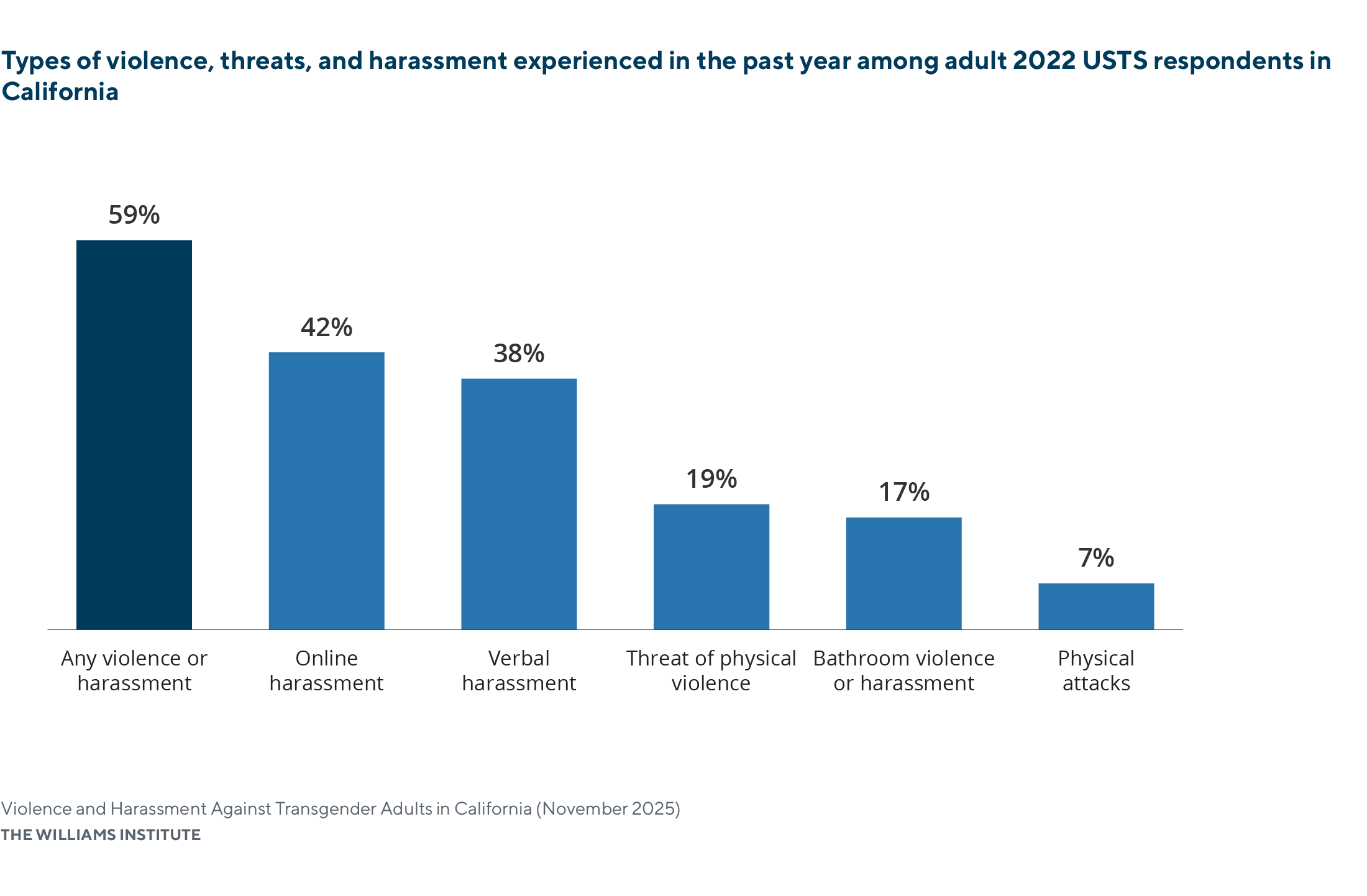
Overall, 59% of California USTS adult respondents experienced at least one incident of violence or harassment in the year prior to completing the survey. The most common form of violence or harassment was online harassment (42%), followed by verbal harassment (38%), threats of physical violence (19%), bathroom-related violence or harassment (17%), and physical attacks (7%).
Physical Attacks
Almost one in ten (7%) California USTS respondents reported experiencing one or more physical attacks in the past year. Among those who experienced physical attacks, the number of incidents ranged from one to five or more (average: 2), with 11% reporting five or more attacks.
- Physical attacks were significantly associated with education and income. Rates were about three times higher among respondents with less than a high school diploma (13%) or an annual income of $1–$24,999 (10%) compared with those holding a bachelor’s degree or higher (4%) or earning $100,000 or more (3%).
- Hispanic or Latine transgender women reported disproportionately high rates of physical attacks (12%), particularly compared with Hispanic or Latine transgender men (5%) and nonbinary individuals (assigned female at birth: 5%; assigned male at birth: 2%).
- Transgender adults who believe they are perceived by others as transgender most or all of the time were more likely to experience physical attacks (10%) than those who are rarely or never perceived as transgender (6%).
- Physical attacks were primarily committed by strangers (66%), and 70% of respondents reported that the attacks involved grabbing, punching, or choking.
Bathroom Violence and Harassment
One in six (17%) California USTS reported experiencing some form of violence or harassment while using a public restroom in the year prior to completing the survey. Respondents who experienced bathroom violence or harassment primarily indicated being told they were using the wrong bathroom (15%), followed by 7% of respondents who indicated other types of verbal harassment, 5% who were denied access, and 1% who experienced physical violence or unwanted sexual contact.
- Experiences of bathroom violence and harassment were particularly pronounced among California USTS respondents who have less than a high school diploma (13%), especially relative to those with a high school diploma (6%), some college experience (5%), or a bachelor’s degree (5%).
- Transgender men had disproportionately high rates of bathroom violence or harassment: 19% of White, non-Hispanic transgender men, 25% of Black, non-Hispanic transgender men, and 20% of Hispanic or Latine transgender men. White, non-Hispanic AFAB nonbinary people (18%) and 21% of Hispanic or Latine AFAB nonbinary people also reported high rates of bathroom violence or harassment.
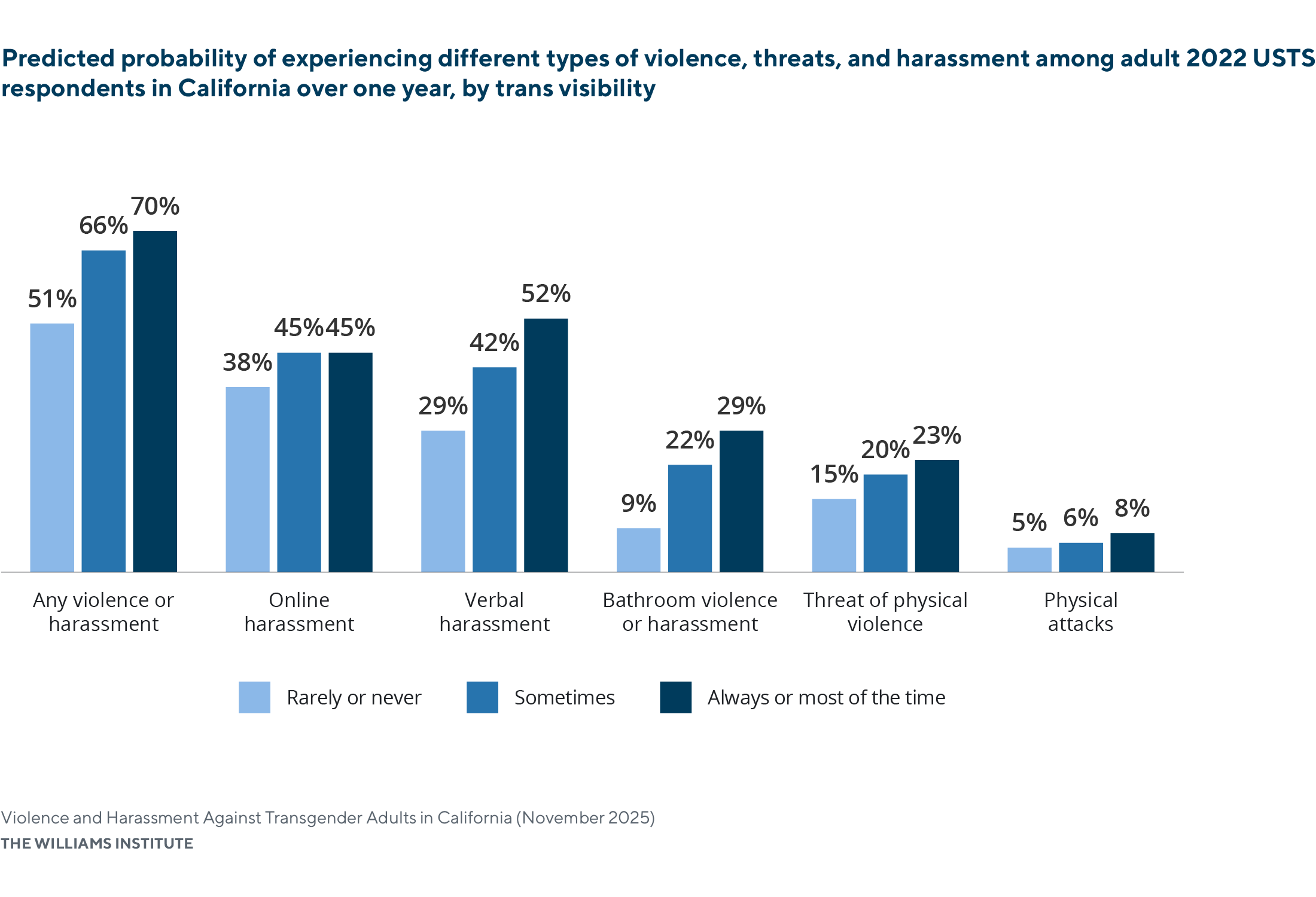
- Trans visibility significantly increased prevalence rates of bathroom violence and harassment. Approximately 20%–40% of transgender adults across gender identities who believed they were perceived as transgender most or all of the time reported experiencing bathroom violence or harassment, compared with 6%–11% among those who were rarely or never perceived as transgender.
- Over two in five (41%) AFAB nonbinary people who believe they are always or most of the time perceived as transgender reported experiencing bathroom violence or harassment in the preceding year, compared to 11% of AFAB nonbinary people who believe they are rarely or never perceived as transgender.
Threats of Physical Violence
Nearly one in five (19%) California USTS respondents were threatened with physical violence in the year prior to completing the survey. On average, respondents who reported experiences of physical violence threats had an average of 2.9 threats in the prior year.
- Experiences of threats were related to income and education level. California USTS respondents with lower educational attainment or lower incomes experienced significantly higher rates of threats in the prior year.
- Over one-fourth (26%) of respondents with less than a high school degree experienced a threat of physical violence in the prior year, compared to 15% among those with a bachelor’s degree or higher.
- Respondents with annual incomes between $1 and $24,999 were more than twice as likely to be threatened with physical violence (26%) as those with household incomes of $100,000 or more (12%).
Verbal Harassment
Over one-third (38%) of California USTS respondents reported experiencing verbal harassment in the year prior to completing the survey. Among those who experienced verbal harassment, the vast majority (84%) believed it occurred because of their transgender status, gender identity, or gender expression. Put differently, nearly one-third (32%) of all California USTS respondents reported experiencing verbal harassment because of their transgender status, gender identity, or gender expression in the year prior to the survey.
- One in five (20%) respondents reported experiencing verbal harassment related to their transgender status or gender by a stranger in a public place in the past year.
- Verbal harassment was more commonly reported among White, non-Hispanic (40%) and Hispanic or Latine (38%) transgender adults.
- Rates of verbal harassment were higher among respondents with lower education and income levels. Nearly half (46%) of those with less than a high school education reported verbal harassment, compared with 35% of those with a bachelor’s degree or higher. Similarly, those earning $1–$24,999 (42%) or $25,000–$49,999 (42%) reported significantly higher rates than those earning $100,000 or more (34%).
- Approximately half (47%–54%) of transgender adults across gender identities who believed they were perceived as transgender most or all of the time reported experiencing verbal harassment, compared with 24%–35% among those who were rarely or never perceived as transgender.
Online Harassment
Online harassment was the most common form of violence or harassment experienced by California USTS respondents in the year prior to completing the survey. It included being called offensive names (33%), followed by intentional embarrassment (21%), sexual harassment (16%), physical threats (12%), sustained harassment (12%), and stalking (9%).
- Nearly half (48%) of younger respondents aged 18–24 reported experiencing online harassment in the past year, compared with 30% of those aged 45 and older.
- AFAB nonbinary respondents reported the lowest rates of online harassment (36%), compared with 46% of AMAB nonbinary respondents, 45% of transgender women, and 42% of transgender men.
- Online harassment rates were highest among several groups, including Hispanic or Latine (48%) and White, non-Hispanic (46%) transgender women; Hispanic or Latine transgender men (45%); White, non-Hispanic AFAB nonbinary people (42%); and AMAB nonbinary people who were Hispanic or Latine (56%) or multiracial/another race (55%).
- Online harassment was closely linked to socioeconomic status. About 35% of transgender adults with a bachelor’s degree or higher or earning $100,000 or more reported experiencing online harassment. In contrast, between 41% and 46% of those with less than a bachelor’s degree, and 44%–47% of those with household incomes between $1 and $74,999, reported similar experiences.
Predictors of Violence and Harassment
Transgender visibility, or the extent to which respondents believed others could tell they are transgender even without disclosure, was the most consistent predictor of experiencing violence or harassment among California USTS respondents. The probability of experiencing each type of violence or harassment was significantly higher among those who believed they were perceived as transgender all or most of the time, compared with those who were rarely or never perceived as transgender, even after controlling for factors such as age, race and ethnicity, gender identity, education, and income.