Overview
On October 31, 2025, the White House published in the Federal Register a Presidential Determination that limits the number of refugees admitted for resettlement under the U.S. Refugee Admissions Program (USRAP) to 7,500 people for Fiscal Year 2026. Most slots will be allocated to white Afrikaners from South Africa “and other victims of illegal or unjust discrimination in the respective homelands.”
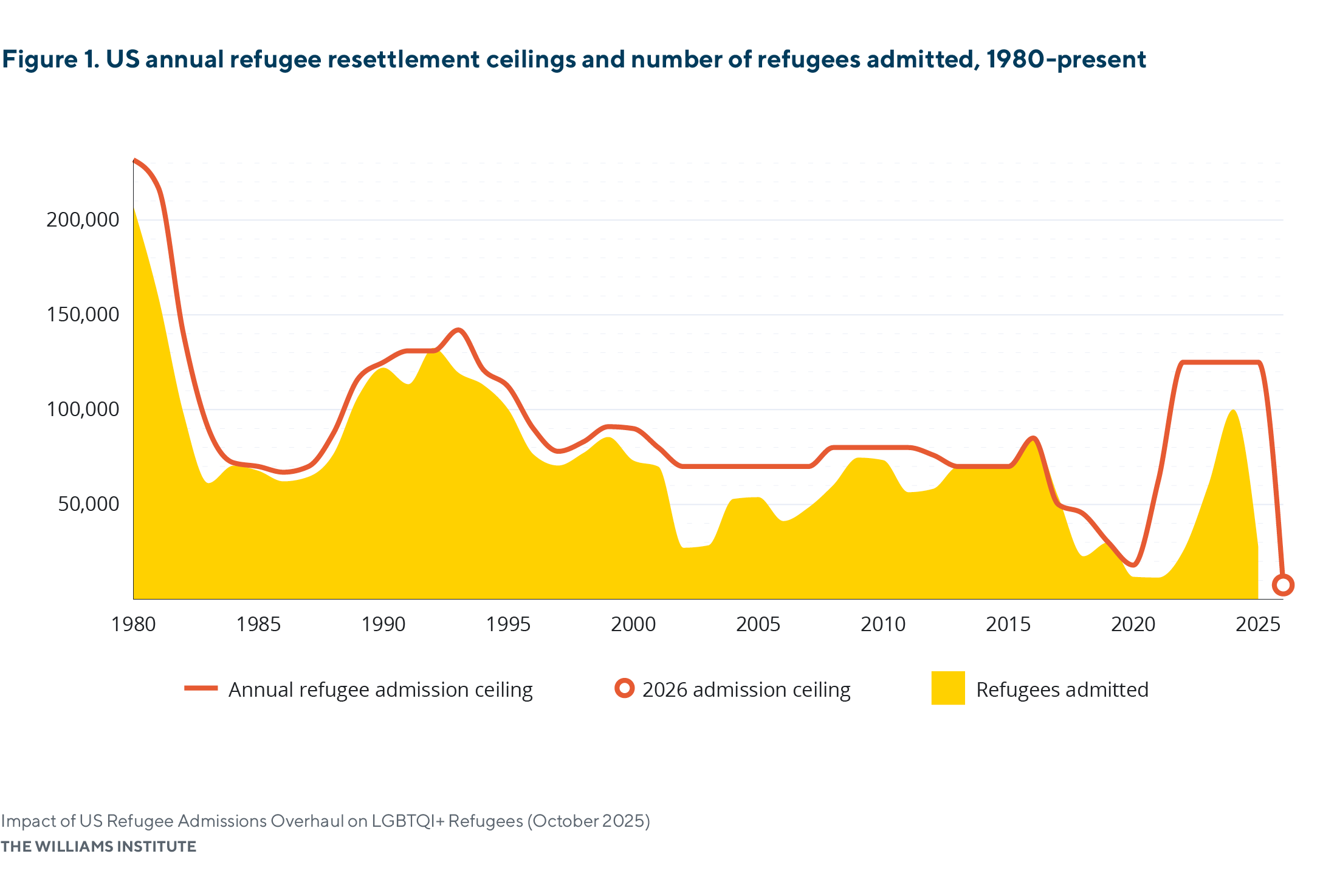
This represents a 94% reduction from the 125,000-person target set during the Biden administration, and a decrease still from the 70,000-80,000-person ceilings established under Presidents Barack Obama and George W. Bush.
For lesbian, gay, bisexual, transgender, queer, intersex, and other sexual- and gender-diverse (LGBTQI+) refugees, this reduction could have a significant impact. This brief examines the implications of this cap for LGBTQI+ refugees awaiting resettlement in the United States, contextualizing it within growing global threats to LGBTQI+ people, the vulnerabilities faced by this population in transit countries, and the persistent challenges of limited data collection on LGBTQI+ refugees that obscure the full scale of need.
US Refugee Admissions
Under U.S. and international law, a refugee is a person who is unable to return to their country of origin due to a fear of being persecuted based on their “race, religion, nationality, membership of a particular social group or political opinion.” This definition distinguishes refugees from other migrants by emphasizing that refugees are
fleeing persecution and cannot return home due to a well-founded fear of harm. Importantly, through landmark legal cases in 1990 and 2000, the U.S. established that sexual orientation and gender identity (SOGI) fall under the category of “membership of a particular social group,” making LGBTQI+ people eligible for refugee status when they face persecution based on their SOGI.
For individuals outside their country of origin who have not yet reached a potential resettlement country, the United Nations High Commissioner for Refugees (UNHCR) typically conducts refugee status determinations. UNHCR has the international mandate to determine who is (and is not) attributed refugee status, to provide refugee assistance, and to decide who is eligible for resettlement in third countries. UNHCR then refers qualified individuals to countries like the United States for resettlement consideration. UNHCR estimates that 2.9 million refugees worldwide are in need of resettlement, yet global resettlement capacity falls far short of this target.
The United States has long maintained an important role in global refugee resettlement. Since the adoption of the Refugee Act of 1980, which established USRAP as a permanent and standardized system for resettling refugees within the United States, the U.S. has resettled nearly 4 million refugees. By law, the President is authorized to set the annual ceiling for refugee admissions, in consultation with Congress and based on national interest and humanitarian concerns. Historically, the United States has been the world’s leading resettlement country, accepting more refugees in most years than all other resettlement countries combined.
Since President Trump’s executive order in January, which suspended the USRAP, only a small number of refugees have been admitted, either as part of ongoing court cases seeking to resume the program or through a new program prioritizing white Afrikaner refugees from South Africa. In May 2025, the administration welcomed its first group of 59 Afrikaners, reaching a total of 138 by early September. The administration claims this group faces discrimination and violence in South Africa, assertions that the South African government has rejected.
Refugee admissions targets have varied over the decades. During the 1980s and 1990s, caps ranged from 67,000 to over 200,000 annually, with higher numbers during the Cold War era to accommodate refugees from Southeast Asia and the former Soviet Union. In the 2000s, caps generally ranged from 70,000 to 80,000, though admissions dropped significantly following the September 11, 2001, terrorist attacks as security procedures were overhauled. During the Biden administration, refugee admissions rebounded significantly after historic lows during the first Trump administration. In FY 2024, the United States resettled 100,034 refugees—the highest number in 30 years. Biden maintained a ceiling of 125,000 for fiscal years 2023, 2024, and 2025.
Drivers of LGBTQI+ Refugees
According to UNHCR, there are currently 36.8 million refugees worldwide. However, the precise number who identify as LGBTQI+ is unknown, given that data on SOGI is not systematically collected among refugee populations. Nevertheless, a growing body of research provides evidence of the harms that drive many LGBTQI+ individuals to leave their country of origin and seek refuge in another.
At least 62 countries maintain laws that criminalize consensual same-sex activity, with punishments ranging from imprisonment to the death penalty. An additional 13 countries criminalize gender-diverse persons through restrictions on gender expression or bans on “cross-dressing.” In 2025, despite a general trend toward decriminalization, Burkina Faso adopted a law that criminalizes consensual same-sex activity, while a legal ruling in Trinidad and Tobago effectively re-criminalized homosexuality after previous reforms. In 2024, seven of the top 10 countries of origin for refugees globally had laws criminalizing homosexuality.
These laws can lead to state-sponsored persecution, including torture. They also stigmatize LGBTQI+ people, which can result in violence from family members, community leaders, gangs, and private citizens. Research shows that LGBTQI+ refugees experience physical assault, harassment, blackmail, mob and gang violence, forced conversion therapy, and sexual violence prior to migration. Transgender refugees are often visible in their gender nonconformity and therefore particularly vulnerable to violence and persecution. Many countries with legal protections for gay and lesbian citizens lack similar protections for transgender people, and transgender individuals frequently experience homelessness and are pushed into unsafe contexts such as sex work. Intersex people also increasingly face violence, including physical and sexual assault, and forced medical intervention to modify their sex characteristics.
Additionally, armed conflict and political violence can drive LGBTQI+ people to seek refuge. Research shows that individuals may be targeted in conflict settings based on their real or perceived LGBTQI+ identity as a form of gender-based violence. This violence includes rape and other forms of sexual assault, along with torture, extrajudicial killings, persecution, and additional attacks on the physical and psychological well-being of LGBTQI+ individuals.
Potential Impact of Cap on LGBTQI+ Refugees
As of October 2025, 128,000 refugees have already been vetted and approved for resettlement in the United States. They now remain in limbo. With millions more displaced worldwide, a cap of 7,500 creates unprecedented competition for resettlement slots and could further limit the number of LGBTQI+ migrants who might otherwise be considered for resettlement. LGBTQI+ refugees, who are often single adults without family ties (having frequently fled family persecution), lack the family reunification pathways that might otherwise prioritize them. Likewise, President Trump has yet to appoint a Special Envoy for the Advancement of LGBTQI+ Rights, who, under the Biden administration, had Priority-1 referral authority to refer at-risk LGBTQI+ individuals to be considered for refugee resettlement by USRAP. Additionally, most of the 7,500 slots will be reserved for white South African Afrikaners, effectively creating a demographic preference that sidelines refugees from other regions and backgrounds.
A new admissions ceiling of 7,500 could also compound existing challenges faced by LGBTQI+ individuals in navigating the refugee status determination (RSD) process. Adjudicators may fail to recognize SOGI-based persecution when it does not conform to their preconceptions, or they may discount claims from individuals who do not fit stereotypical notions of LGBTQI+ identity. In refugee camps and transit settings where RSD occurs, staff may not create safe environments for disclosure of one’s SOGI, and interpreters may lack appropriate terminology or cultural sensitivity. These systemic deficiencies mean that even when LGBTQI+ refugees are among those waiting for resettlement, they may not be identified as priority cases or may have their claims dismissed during the RSD process.
Notably, the cap could force LGBTQI+ refugees and those seeking refugee status to remain in host countries or in other precarious situations along the migratory route. Studies show that LGBTQI+ refugees face distinct difficulties navigating transit zones, where they experience daily harassment, violence, and discrimination. While fleeing persecution in their home countries, these individuals often find themselves trapped for months or years in host countries that offer little safety or protection.
Uganda, for example, is Africa’s largest host country, hosting nearly 2 million refugees. In 2023, it passed one of the most draconian anti-LGBTQI+ laws in the world, applying the death penalty for cases of “aggravated homosexuality.” In South Africa, LGBTQI+ migrants in transit reported fearing sexual assault and social isolation. Another study in Lebanon found that sexual minority Syrian refugees reported higher rates of discrimination and assault compared to non-sexual minority Syrians. Studies also found migrants enduring abuse and discrimination from local residents in host countries. This ongoing persecution forces many LGBTQI+ refugees to conceal their identities to avoid abuse or violence in transit countries. This forced invisibility can impact mental and physical health outcomes. Individuals who fled their home countries, hoping to live openly and authentically, instead find themselves continuing to hide fundamental aspects of who they are. This concealment also prevents them from accessing LGBTQI+-specific support services that might otherwise be available, deepening their isolation and vulnerability.
The economic dimensions of waiting in transit heighten these dangers. LGBTQI+ refugees lacking financial resources face severe financial strain during what can stretch into years. Many experience difficulties obtaining residence permits necessary to begin employment, leaving them dependent on rapidly depleting savings or support from aid organizations. This economic precarity can push them into exploitative situations or unsafe work, including survival sex work, which exposes them to further violence and health risks. The inability to work legally also means they cannot plan for their futures or maintain any sense of stability while waiting.
Even where support services may exist, LGBTQI+ people report difficulty or discrimination in accessing care. Studies show that health care, mental health services, and legal aid may be inaccessible due to language barriers, and homophobia or transphobia among service providers. Transgender and intersex individuals, in particular, may be unable to obtain medication or access required medical care. And mental health support—critically needed given the compounding traumas of persecution, displacement, and ongoing danger—is rarely available in forms that are sensitive to the needs of LGBTQI+ people.
Current Data Challenges
A critical lack of data on the LGBTQI+ refugee population compounds the likely impact of the refugee admissions cap. The data gap exists because countries and agencies working with refugees, including the U.S. government, do not systematically collect demographic data that include measures of sexual orientation, gender identity, or sex characteristics. UNHCR and most national refugee agencies lack standardized questions on SOGI in registration and data management systems. When data are collected, they are often inconsistently coded.
Consequently, policymakers, service providers, and advocates cannot fully quantify how many LGBTQI+ refugees are waiting for resettlement, how many are in immediate danger in transit countries, or what proportion of the 128,000 refugees already vetted for resettlement in the United States identify as LGBTQI+. When allocation decisions are made under a drastically reduced cap, the urgent needs of LGBTQI+ refugees are likely to remain invisible.
Conclusion
The overhaul of U.S. refugee admissions, including the cap of 7,500 for Fiscal Year 2026, represents a dramatic shift and would likely impact LGBTQI+ refugees fleeing persecution. This reduction exacerbates existing challenges that LGBTQI+ refugees must navigate, including heightened vulnerabilities in transit countries, barriers in refugee status determination processes that may not recognize SOGI-based persecution, and the absence of systematic data collection that leaves their needs invisible in resettlement decisions. This change would likely add another hurdle for LGBTQI+ refugees and severely constrain their prospects for reaching safety through U.S. resettlement.
Download the full brief