Brief

LGBTQ Perspectives on Police Participation in Pride Events

June 2026

Police participation at LGBTQ Pride events is rooted in a long history of conflict between LGBTQ communities and law enforcement. Using data from the 2022 Policing the Rainbow study, this brief examines LGBTQ people’s perceptions of police presence at Pride events

AUTHORS
Highlights
Support for police presence varies across the LGBTQ community with lesbian and gay people most likely to be in favor.
Those who identify as queer, transgender, nonbinary, and younger LGBTQ people, show the least support.
LGBTQ people with high socioeconomic status are most likely to support police presence and least likely to oppose it.
Data Points
48%
of LGBTQ adults support police presence at Pride
19%
oppose their presence
Brief

Contemporary debates about police participation at LGBTQ Pride events are rooted in a long history of conflict between LGBTQ communities and law enforcement. For much of U.S. history, LGBTQ identities and behaviors were criminalized through laws targeting same-sex intimacy, gender nonconformity, public gathering, and sodomy.1 Collective memory of police raids on LGBTQ spaces continues to shape tensions surrounding police engagement with LGBTQ communities.2  One of the first recorded acts of resistance to police harassment occurred at Cooper Do-Nuts in Los Angeles in 1959, when LGBTQ patrons reportedly resisted arrest by throwing a deluge of donuts, coffee, and garbage at raiding officers.3  A decade later, the 1969 Stonewall uprising marked a pivotal moment in LGBTQ resistance to policing, as patrons resisted a police raid over several days.4  The following year, the first Christopher Street Liberation Day March commemorated the uprising and became the foundation for modern Pride parades.5

Police participation in LGBTQ Pride parades and events remains a recurring and often contentious issue as Pride celebrations begin each year across the United States.6  These debates are closely tied to broader questions about the nature and purpose of Pride itself. Scholars and activists frequently describe a transformation of Pride from a site of protest and resistance to one centered more on celebration, institutional inclusion, and commercialization.7  Unlike the police raids that catalyzed early LGBTQ demonstrations, contemporary police presence at Pride events is often formalized through municipal permitting processes or invitations from organizers seeking to promote safety and inclusion. For some LGBTQ people, police participation in Pride represents progress in police-community relations and protects attendees from anti-LGBTQ protesters. Others view police participation as a form of “pinkwashing”8 that obscures ongoing historical and present-day patterns of police violence and discrimination against LGBTQ communities.9

Research shows that LGBTQ people view police more negatively than non-LGBTQ people.10 Although law enforcement agencies have undertaken efforts to improve relationships with LGBTQ communities,11 the legacy of anti-LGBTQ policing, combined with contemporary perceptions and experiences of bias, continues to hinder these efforts. LGBTQ people report lower willingness to interact with the police.12 LGBTQ youth and adults are less likely to report experiences of victimization, often citing concerns about anti-LGBTQ bias in law enforcement.13 Research focusing on transgender experiences further documents police profiling, victim dismissal, assumed criminality, intentional misgendering, and other forms of gender-based violence and mistreatment.14

Broader views of policing also shape attitudes toward police participation in Pride events.15 Although debates over police participation in Pride frequently appear in mainstream media and public commentary,16 limited research has explored these perceptions more systematically. Police participation in Pride events can take many forms, ranging from law enforcement and security functions to marching in Pride parades, either in uniform or in plainclothes. Because police involvement encompasses a variety of roles and levels of visibility, individuals may differ in what they consider “participation,” and these interpretations may shape their support for police involvement in Pride events. Supporters often emphasize narratives of progress and view problems with policing as less relevant to their local context.17 Opponents point to continued negative experiences with police, especially among LGBTQ people of color and lower-income LGBTQ individuals.18 Research also indicates that many LGBTQ people hold ambivalent views toward police presence at Pride, seeking protection from anti-LGBTQ violence while remaining skeptical of police willingness or ability to provide such protection.19 Some demographic factors have also been shown to shape these attitudes, with support for police participation generally increasing alongside income.20

Although existing commentary and research suggest LGBTQ people hold mixed views about police participation in Pride events, most prior studies are limited to specific locales or rely on relatively small, non-representative samples. In this report, we contribute to the conversation by providing national estimates of LGBTQ people’s perceptions of police participation in Pride events.

Perspectives on Police Participation in Pride Events

We analyzed LGBTQ people’s perspectives on police participation in LGBTQ Pride events using data from the Policing the Rainbow study, the first nationally representative survey examining LGBTQ people’s experiences with and perceptions of the police. Respondents were asked to indicate the extent to which they agreed or disagreed with the following statement: “Police should participate in LGBTQ Pride events to show their support.”21

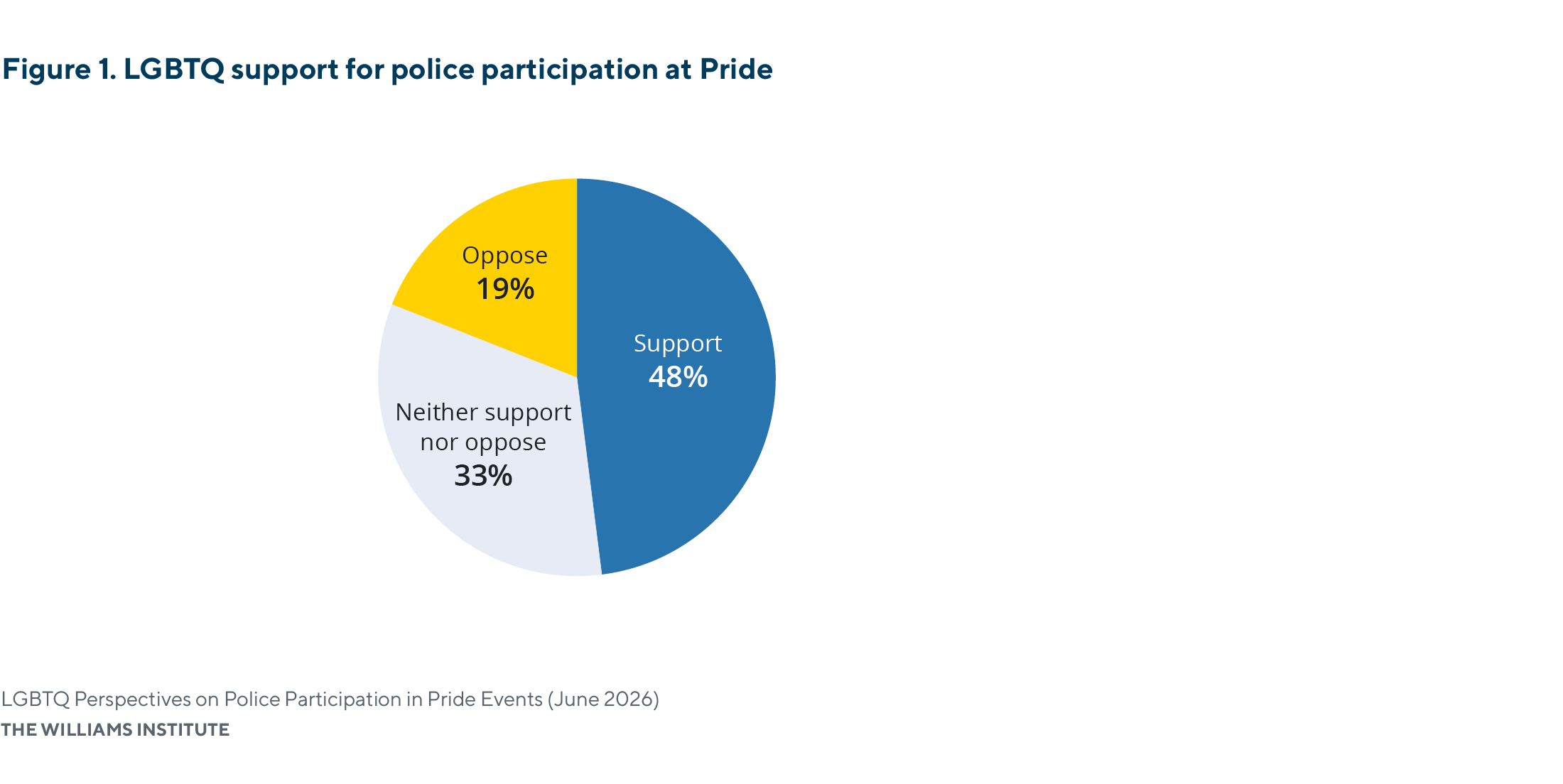
Overall, we found that 48% of LGBTQ adults supported police participation in Pride events, while 19% opposed it and 33% expressed ambivalent views (“neither support nor oppose”).
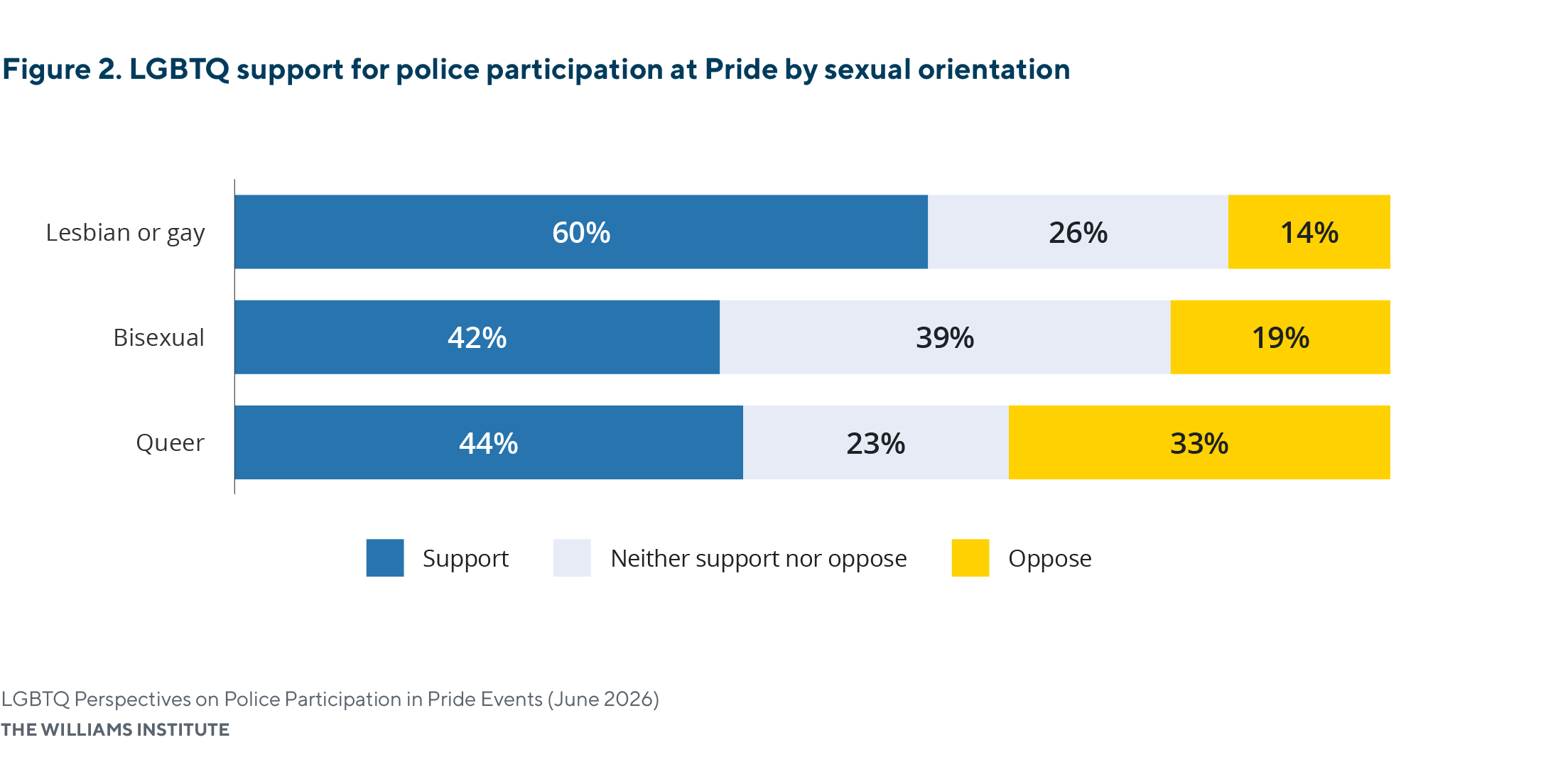
Support for police participation at Pride events varied by sexual orientation.22 Respondents who identified as lesbian or gay were the most likely to support police participation (60%), compared to 42% of those who identified as bisexual and 44% of those who identified as queer. Queer respondents were also the most likely to oppose police participation (33%), with opposition rates more than twice those of lesbian and gay respondents (14%).

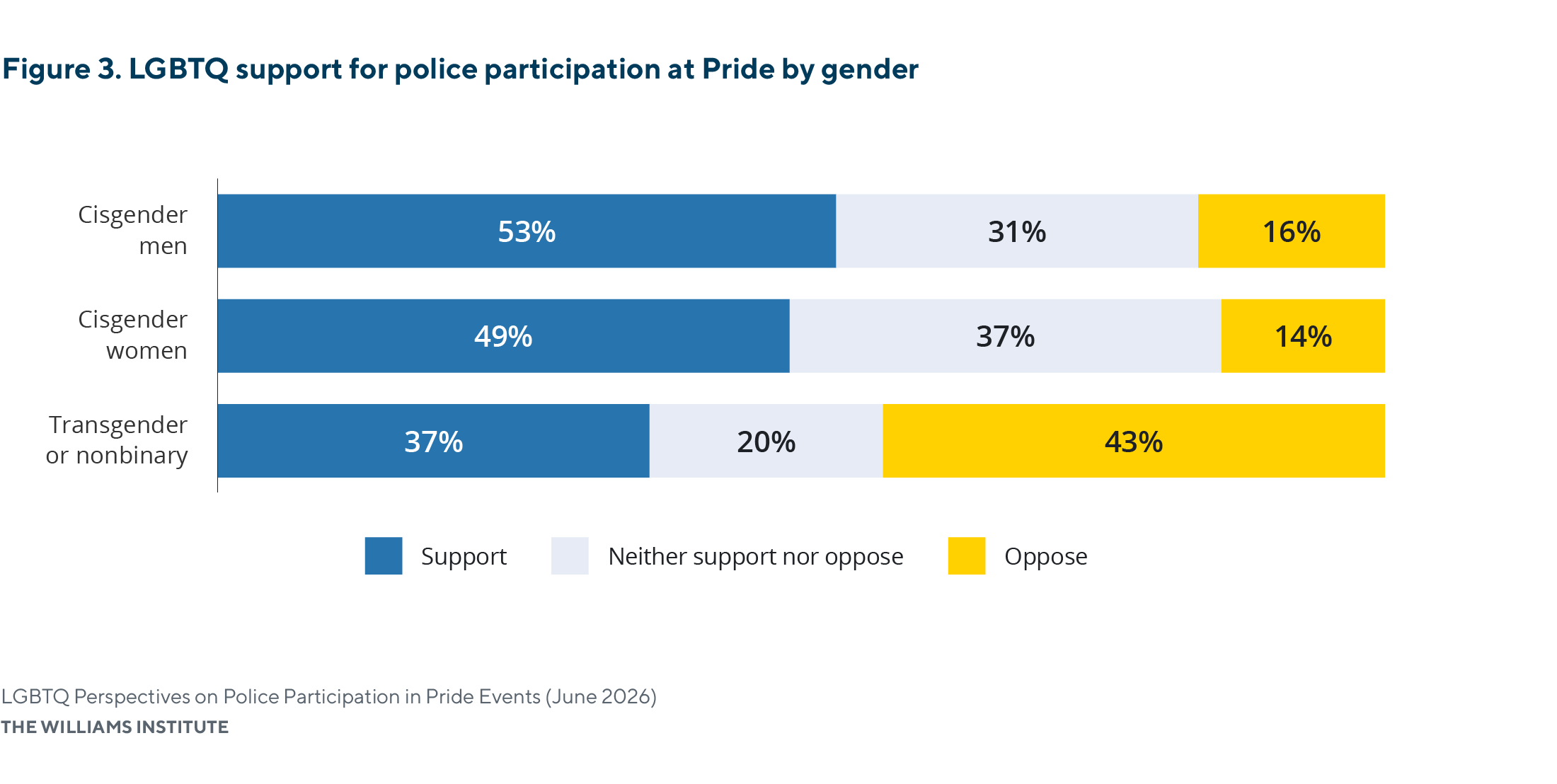
Support for police participation at Pride events also varied by gender identity.23 About half of cisgender men (53%) and cisgender women (49%) supported police participation at Pride events. Transgender and nonbinary respondents were the least likely to support police participation, with only 37% expressing support. Transgender and nonbinary people (43%) were also roughly three times more likely than their cisgender counterparts (men: 16%; women: 14%) to oppose police participation.

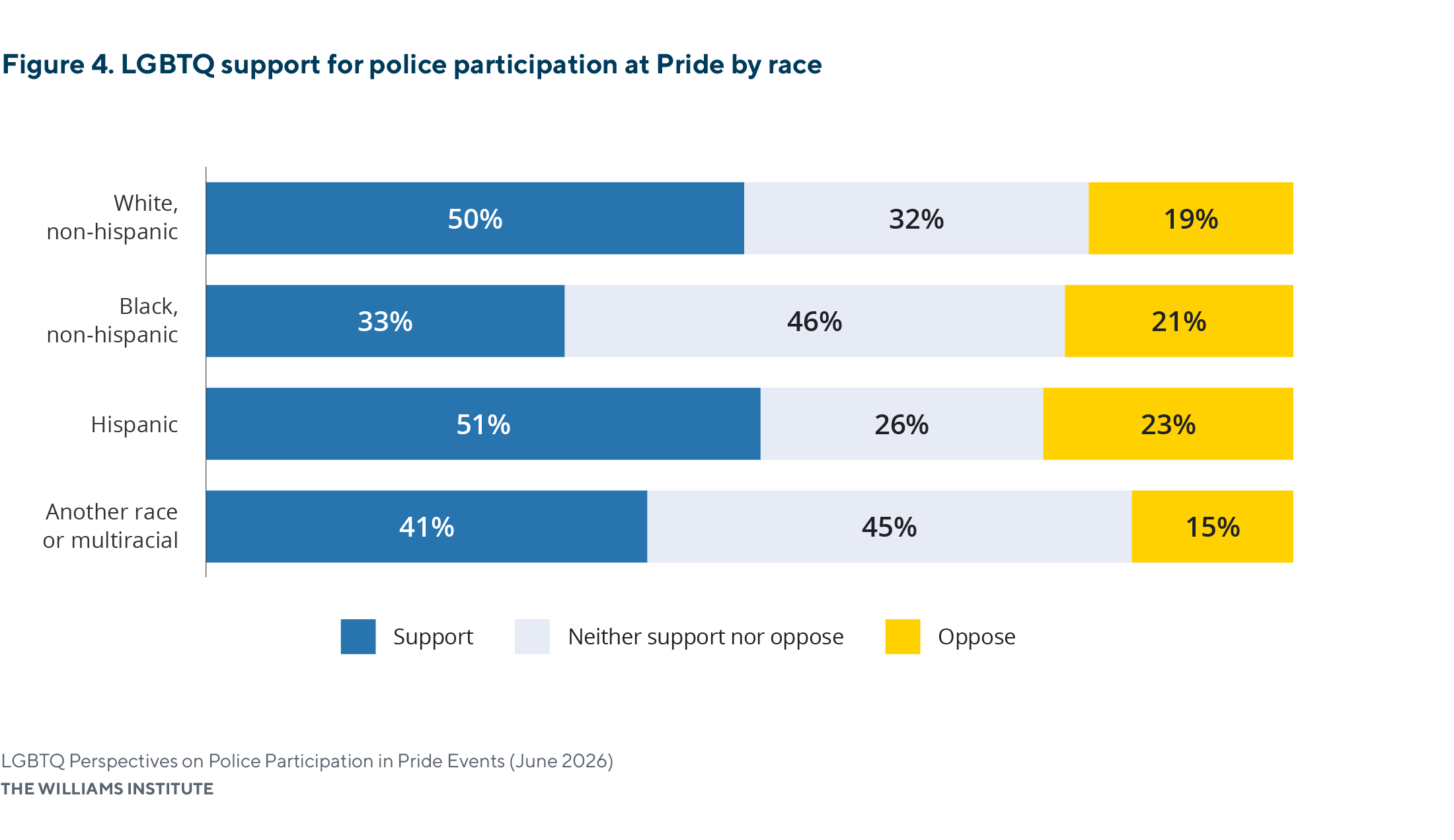
Support for police participation at Pride events did not significantly differ by race or ethnicity.24 While white, non-Hispanic (50%) and Hispanic (51%) respondents held the highest levels of support for police participation, levels of support and opposition were relatively consistent across racial and ethnic groups.

Figure 4. LGBTQ support for police participation at Pride by race

Note: Totals may not add to 100% due to rounding.

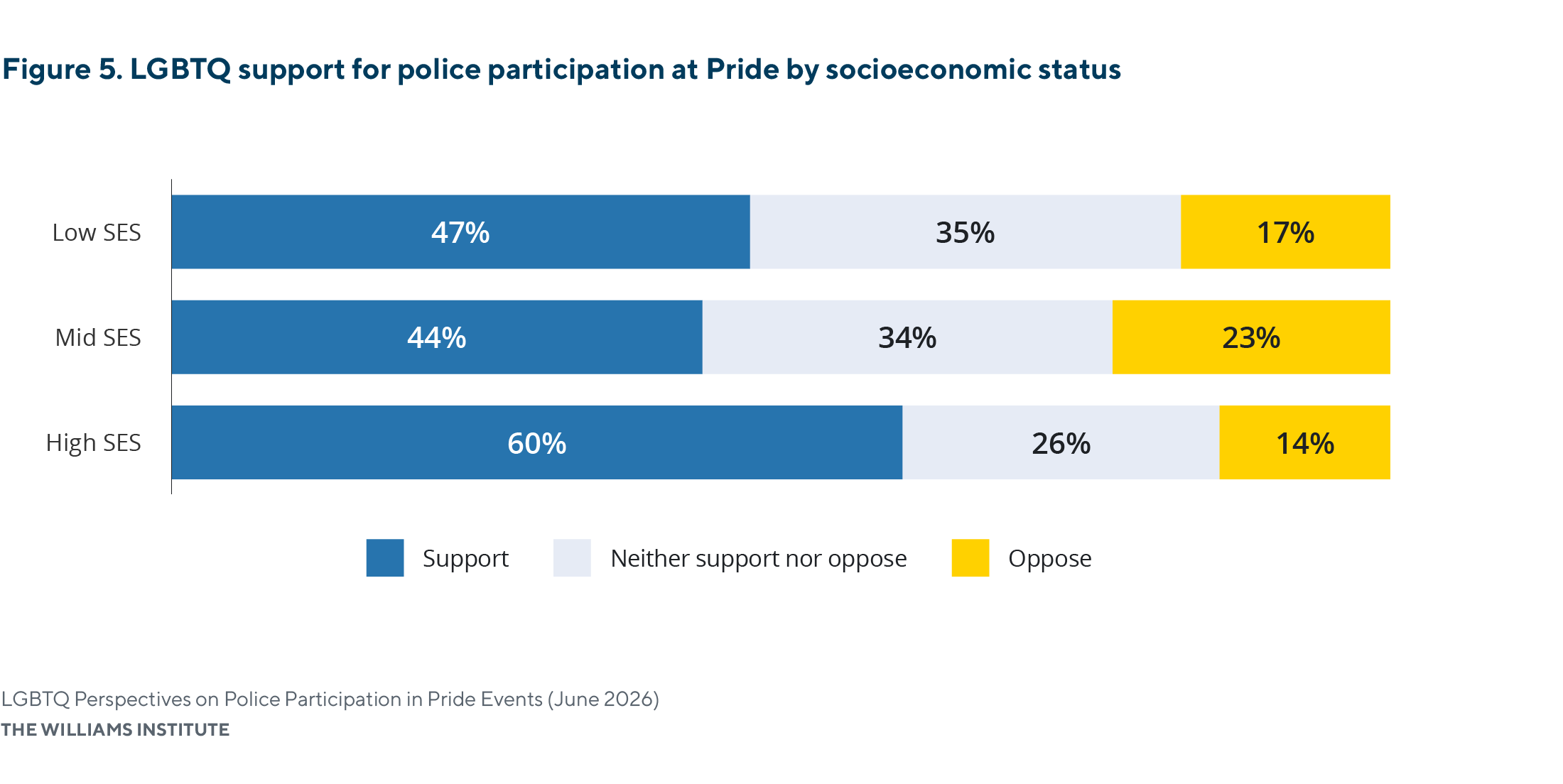
Consistent with some prior research,25 support for police participation was associated with socioeconomic status.26 LGBTQ people with high socioeconomic status27 were the most likely to support police participation (60%) and the least likely to oppose it (14%). In comparison, 47% of LGBTQ people with low socioeconomic status and 44% of those with middle socioeconomic status supported police participation at Pride events.

Figure 5. LGBTQ support for police participation at Pride by socioeconomic status

Note: Totals may not add to 100% due to rounding.

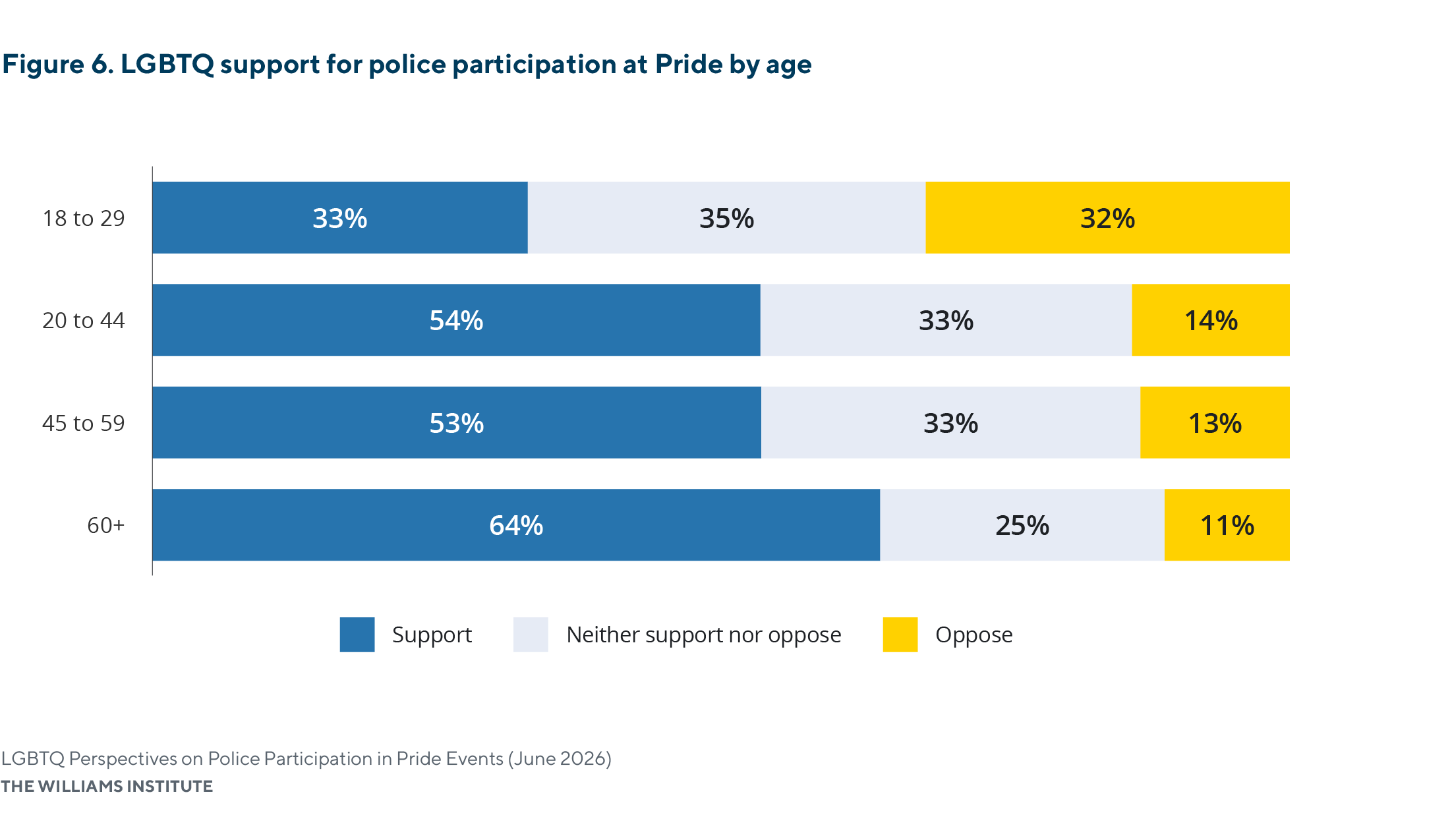
Younger LGBTQ people were less likely to support police participation at Pride events than their older counterparts.28 One-third (33%) of LGBTQ people ages 18–29 supported police participation, compared to between 53% and 64% of older LGBTQ adults. Younger LGBTQ people aged 18 to 29 (32%) were also two to three times more likely to oppose police participation at Pride events than their older counterparts (11%-14%).

Figure 6. LGBTQ support for police participation at Pride by age

Note: Totals may not add to 100% due to rounding.

Conclusion

Consistent with prior qualitative and narrative accounts, our findings show LGBTQ adults are divided in their views on police participation in Pride events. While nearly half of LGBTQ adults in the United States supported police participation, nearly 20% opposed it, and another one-third were ambivalent. Notably, individuals who identified as queer, transgender, or nonbinary were more likely to oppose the presence of police at Pride than their counterparts. Younger LGBTQ adults were also more likely to express opposition. These patterns are consistent with prior research showing that these groups experience more negative interactions with police and are more likely to view the idea of policing as a source of safety within their communities with skepticism.29 The divisions observed in these findings highlight that, as seen in public debates on the question of police presence at Pride, LGBTQ communities are not monolithic in their perceptions of police and that those members of the community most vulnerable to negative police interactions express the greatest opposition. Moreover, there is a need for continued dialogue and research on LGBTQ people’s perceptions of and experience with police, including police participation in Pride events and broader questions of safety, inclusion, and representation within LGBTQ communities.

Download the full brief

LGBTQ Perspectives on Police Participation in Pride Events

Mogul, J. L., Ritchie, A. J., & Whitlock, K. (2011). Queer (In)Justice: The Criminalization of LGBT People in the United States. Beacon Press.

Arrayales, J., Mallory, C., & Grasso, J. (2025). Law enforcement and LGBTQ people. The Williams Institute. https://williamsinstitute.law.ucla.edu/wp-content/uploads/Police-Interactions-LGBTQ-Nov-2025.pdf; Mogul, J. L., Ritchie, A. J., & Whitlock, K. (2011). Queer (In)Justice: The Criminalization of LGBT People in the United States. Beacon Press; Sears, C. (2015). Arresting Dress: Cross-Dressing, Law, and Fascination in Nineteenth Century San Francisco. Duke University Press.

Gay, R. (2021). Cops don’t belong at Pride. The New York Times. https://www.nytimes.com/2021/05/29/opinion/culture/lgbtq-police-pride-parade. html; Rechy, J. (2013). City of night. Grove/Atlantic, Inc.; Stryker, S. (2008). Transgender history. Seal Press: Publishers Group West.

Duberman, M. B. (1993). Stonewall. Dutton

Bruce, K. M. (2016). Pride parades: How a parade changed the world. New York: New York University Press; Duberman, M. B. (1993). Stonewall. Dutton; Goodin, C. (2025). The Unsung Heroines of Stonewall. National Parks Conservation Association. https://www.npca.org/articles/2736-the-unsung-heroines-of-stonewall; Stryker, S. (2008). Transgender history. Seal Press: Publishers Group West.

Contreras, R. (2022). More Pride events banning police from parades. Axios. https://www.axios.com/2022/06/01/lgbtq-pride-events-police; Cramer, M., Stack, L., & Baker, C. (2025, June 29). Police officers protest Pride after being barred from marching with guns. The New York Times. https://www. nytimes.com/2025/06/29/nyregion/gay-nypd-nyc-pride-march.html; Gay, R. (2021). Cops don’t belong at Pride. The New York Times. https://www. nytimes.com/2021/05/29/opinion/culture/lgbtq-police-pride-parade.html; Moroney, R. (2026). Should Long Beach police march in the Long Beach Pride Parade? Q Voice News. https://qvoicenews.com/2026/05/14/should-long-beach-police-march-in-the-long-beach-pride-parade/; New York Times Editorial Board. (2021). A misstep by the organizers of Pride. The New York Times. https://www.nytimes.com/2021/05/18/opinion/nyc-pride-police-parade.html

Bruce, K. M. (2016). Pride parades: How a parade changed the world. New York: New York University Press; Nevius, D. (2018). The first Pride was a riot: How queer activism has partnered with police to hurt the community’s most vulnerable. Hastings Journal on Gender and Justice, 29(1), 125–146.

For more on pinkwashing, see Listek, B. (2024, February 12). Pinkwashing 101: Definition, history, examples. Human Rights Careers. https://www.humanrightscareers.com/issues/pinkwashing-definition-history-examples/

Troia, B. (2025). “They provide the illusion of safety”: Police at Pride and the politics of belonging. Sociological Perspectives, 1–19.

Grasso, J., Vogler, S., Greytak, E., Kindall, C., & Jenness, V. (2024). Policing progress: Findings from a national survey of LGBTQ+ people’s experiences with law enforcement [ACLU]. https://www.aclu.org/publications/policing-progress-findings-from-a-national-survey-of-lgbtq-peoples-experiences-with-law-enforcement; Owen, S. S., Burke, T. W., Few-Demo, A. L., & Natwick, J. (2018). Perceptions of the police by LGBT communities. American Journal of Criminal Justice, 43(3), 668–693; Serpe, C. R., & Nadal, K. L. (2017). Perceptions of police: Experiences in the trans* community. Journal of Gay & Lesbian Social Services, 29(3), 280–299.

Dwyer, A., Ball, M., Bond, C., Lee, M., & Crofts, T. (2019). What stops LGBTI people seeking support from LGBTI police liaison officers? Trends and Issues in Crime and Criminal Justice; Vogler, S., Grasso, J., Cisneros, N., & Jones, M. M. (2026). Law enforcement and victim services providers’ perspectives on LGBTQ liaison officers. The Williams Institute.

Arrayales, J., Mallory, C., & Grasso, J. (2025). Law enforcement and LGBTQ people. The Williams Institute. https://williamsinstitute.law.ucla.edu/wp-content/uploads/Police-Interactions-LGBTQ-Nov-2025.pdf; Briones-Robinson, R., Powers, R. A., & Socia, K. M. (2016). Sexual Orientation Bias Crimes: Examination of Reporting, Perception of Police Bias, and Differential Police Response. Criminal Justice and Behavior, 43(12), 1688–1709; Dwyer, A., & Tomsen, S. (2016). The Past Is the Past? The Impossibility of Erasure of Historical LGBTIQ Policing. In A. Dwyer, M. Ball, & T. Crofts (Eds.), Queering Criminology (pp. 36–53). Palgrave Macmillan UK; Girardi, R. (2022). ‘It’s easy to mistrust police when they keep on killing us’: A queer exploration of police violence and LGBTQ+ Victimization. Journal of Gender Studies, 31(7), 852–862; Grasso, J. C., Jenness, V., & Vogler, S. (2023). Understanding the context for police avoidance: The impact of sexual identity, police legitimacy and legal cynicism on willingness to report hate crime. Current Issues in Criminal Justice, 35(2), 269–289; Owen, S. S., Burke, T. W., Few-Demo, A. L., & Natwick, J. (2018). Perceptions of the police by LGBT communities. American Journal of Criminal Justice, 43(3), 668–693; Russell, E. K. (2019). Queer Histories and the Politics of Policing. Routledge.

Briones-Robinson, R., Powers, R. A., & Socia, K. M. (2016). Sexual Orientation Bias Crimes: Examination of Reporting, Perception of Police Bias, and Differential Police Response. Criminal Justice and Behavior, 43(12), 1688–1709; Girardi, R. (2022). ‘It’s easy to mistrust police when they keep on killing us’: A queer exploration of police violence and LGBTQ+ Victimization. Journal of Gender Studies, 31(7), 852–862.

Avalos, S., & Carrillo, A. (2024). ‘Took my money, called me a guy, and made me sleep in jail overnight’: Police procedural failings when interacting with trans folx. Policing and Society, 34(6), 489–504; Lennon-Dearing, R., Cisneros, N., Grasso, J., & Sears, B. (Forthcoming). Experiences of Transgender Sex Workers Living with HIV In Memphis, Tennessee. The Williams Institute; Serpe, C. R., & Nadal, K. L. (2017). Perceptions of police: Experiences in the trans* community. Journal of Gay & Lesbian Social Services, 29(3), 280–299.

Importantly, much of the empirical research on police participation in Pride events and parades has been conducted in Australia and Canada. Although these debates are ongoing in the U.S. context, relatively little research has examined these dynamics domestically.

For some recent examples, see Cuby, M. (2021, May 21). No, New York Times, Pride organizers didn’t “misstep” by banning uniformed cops. Them. https://www.them.us/story/new-york-times-cops-at-pride-op-ed; Gay, R. (2021, May 29). Cops Don’t Belong at Pride. The New York Times. https://www.nytimes.com/2021/05/29/opinion/culture/lgbtq-police-pride-parade.html; The New York Times Editorial Board. (2021, May 18). A misstep by the organizers of Pride. The New York Times. https://www.nytimes.com/2021/05/18/opinion/nyc-pride-police-parade.html

Holmes, A. (2021). Marching with Pride? Debates on uniformed police participating in Vancouver’s LGBTQ Pride parade Journal of Homosexuality, 68(8), 1320–1352; Troia, B. (2025). “They provide the illusion of safety”: Police at Pride and the politics of belonging. Sociological Perspectives, 1–19.

Arrayales, J., Mallory, C., & Grasso, J. (2025). Law enforcement and LGBTQ people. The Williams Institute. https://williamsinstitute.law.ucla.edu/wp-content/uploads/Police-Interactions-LGBTQ-Nov-2025.pdf; Holmes, A. (2021). Marching with Pride? Debates on uniformed police participating in Vancouver’s LGBTQ Pride parade. Journal of Homosexuality, 68(8), 1320–1352; Nevius, D. (2018). The first Pride was a riot: How queer activism has partnered with police to hurt the community’s most vulnerable. Hastings Journal on Gender and Justice, 29(1), 125–146.

Troia, B. (2025). “They provide the illusion of safety”: Police at Pride and the politics of belonging. Sociological Perspectives, 1–19.

Gillespie, W. (2008). Thirty-five years after Stonewall: An exploratory study of satisfaction with police among gay, lesbian, and bisexual persons at the 34th Annual Atlanta Pride Festival. Journal of Homosexuality, 55(4), 619–647.

The survey question did not distinguish among different forms of police participation in Pride events, leaving respondents to define participation subjectively. Additional information about the measure is provided in the Methods section.

χ²(6) = 41.36, design-based F(5.57, 4385.26) = 3.83, p < 0.001

χ²(4) = 54.69, design-based F(3.88, 2970.09) = 8.11, p < 0.001

χ²(6) = 14.81, design-based F(5.75, 4542.41) = 1.62, p > 0.05

Gillespie, W. (2008). Thirty-five years after Stonewall: An exploratory study of satisfaction with police among gay, lesbian, and bisexual persons at the 34th Annual Atlanta Pride Festival. Journal of Homosexuality, 55(4), 619–647.

χ²(4) = 14.32, design-based F(3.88, 3062.93) = 2.60, p < 0.05

Socioeconomic status is a composite measure consisting of measures related to income, housing, and employment status.

χ²(6) = 54.10, design-based F(5.75, 4539.41) = 6.42, p < .001.