Brief

Impacts of Immigration Enforcement on LGBT Adult Immigrants in Los Angeles County

June 2025

Using research from the Williams Institute, the University of Southern California Dornsife Equity Research Institute, and the Pew Research Center, this brief estimates the number of foreign-born LGBT adults in Los Angeles County who could potentially be impacted by heightened immigration activities in the region.

Highlights
On June 7, ICE operations began across Los Angeles with over 100 people arrested in the first three days.
Nearly 50,000 LGBT immigrants in LA County do not have U.S. citizenship.
Immigration enforcement may be felt most severely in racially diverse Supervisorial Districts 1 and 2.
Data Points
122,000
LGBT adult immigrants live in LA County
49,000
do not have U.S. citizenship
Brief

Overview

During his campaign, President Donald Trump stated that he would reduce pathways for legal immigration and remove immigrants without documentation from the U.S. On January 20, 2025, he signed an executive order, “Protecting the American People Against Invasion,”1 directing federal agencies to intensify efforts to identify, detain, and deport undocumented immigrants. In the following months, Trump administration officials tripled daily immigration arrest quotas from 1,000 to 3,000 by the end of May.2 On Friday, June 7, widespread Immigration and Customs Enforcement operations occurred across Los Angeles, leading to at least 40 arrests on Friday alone and over 100 by the end of the weekend, prompting widespread protests.3 Trump officials have since vowed to continue enforcement operations in Los Angeles “every day.” Against the will of the Governor of California, President Trump also federalized the California National Guard, deploying 4,000 National Guard troops and 700 Marines to the streets of Los Angeles in response to the protests.4

Using previous Williams Institute studies and reports from the University of Southern California Dornsife Equity Research Institute5 and the Pew Research Center,6 this brief estimates the number of foreign-born LGBT adults in Los Angeles County potentially affected by the executive order and subsequent activities toward mass deportations.

LGBT Immigrants in Los Angeles County

There are over 1.25 million LGBT adult immigrants in the U.S.,7 and more than 30% of these immigrants live in California.8 With an estimated 122,000 LGBT immigrants residing across the county, Los Angeles is home to nearly 10% of all LGBT adult immigrants in the United States.9

According to a previous Williams Institute analysis of the Los Angeles County Health Survey, 18% of LGBT people in the county were born outside of the United States, including 7% who are not citizens.10 Therefore, out of the estimated 665,000 LGBT people in Los Angeles County, 122,000 are immigrants, of which approximately 49,000 do not have U.S. citizenship.11

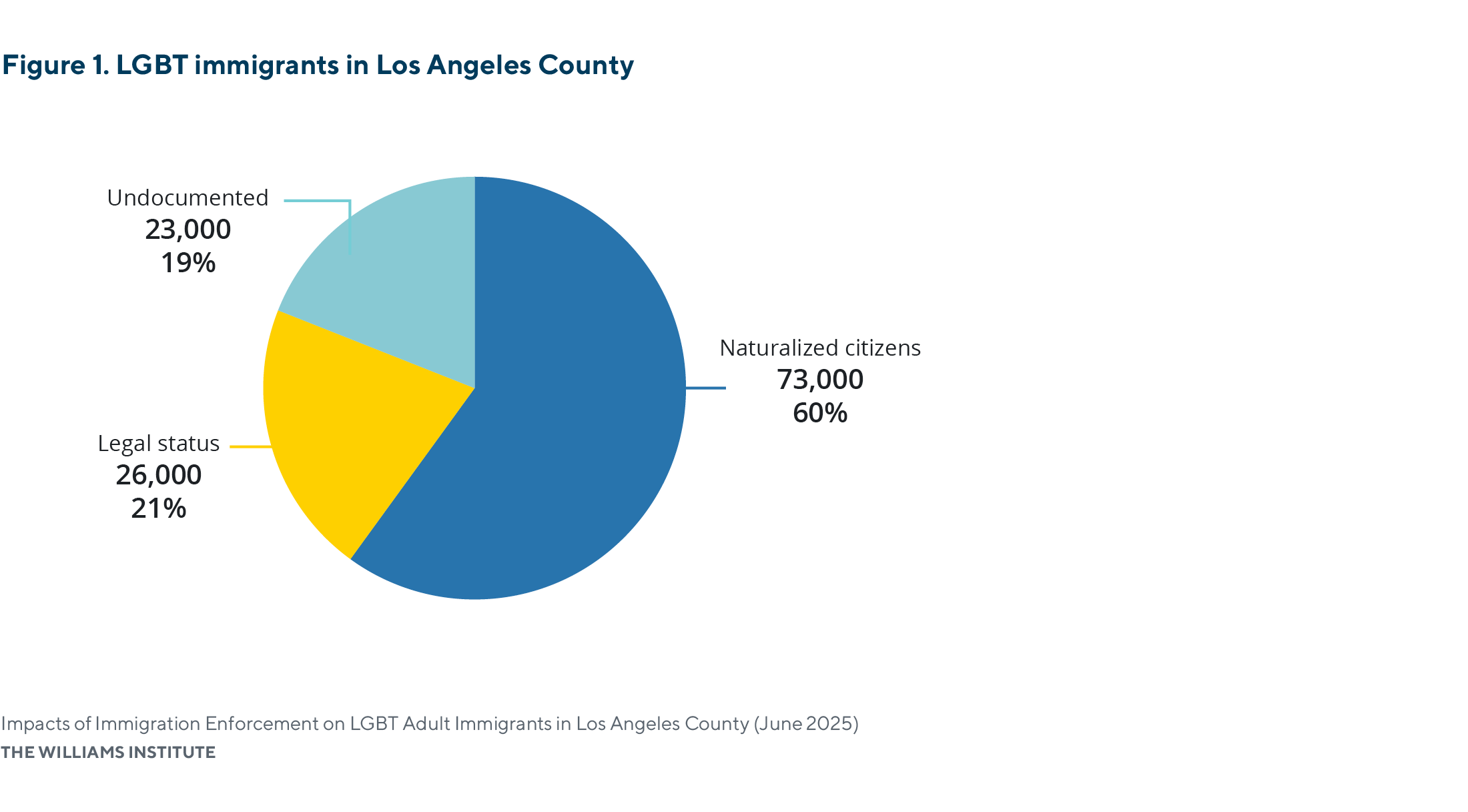
To estimate how many of the 49,000 LGBT non-citizens are undocumented, we used research done by the Pew Research Foundation and by the USC Dornsife Equity Research Institute, which found, in separate studies, that approximately 53% of non-citizen immigrants to the U.S. have some form of legal status. Approximately 47% of non-citizen immigrants to the U.S. are undocumented. Applying those proportions to the 49,000 LGBT non-citizens in Los Angeles County, we estimate that there are approximately 23,000 undocumented LGBT adults.12 The remaining estimated 26,000 LGBT non-citizens in Los Angeles County are immigrants who have documents proving lawful residency.13

Among LGBT adult immigrants in California, approximately 41,000 are transgender or nonbinary, with over 5,200 (approximately 13% of the state population) residing in Los Angeles County.14 Using the proportions from the Pew Research Foundation and the USC Dornsife Equity Research Institute cited above, we estimate that approximately 3,100 transgender and non-binary immigrants in Los Angeles County are naturalized citizens, more than 1,100 have legal status, and just under 1,000 are undocumented.15

Impacts of Increased Immigration Activities on LGBT Adult Immigrants in Los Angeles

While LGBT immigrants who are undocumented face the clearest and most immediate risks of detention and deportation, LGBT immigrants who hold legal status but are not naturalized citizens may also face challenges to their legal right to reside in the U.S. Some recent reports indicate that non-citizens with legal status are being swept up in immigration enforcement operations.16 Several forms of legal status in place at the end of the Biden administration, including Temporary Protected Status (TPS) for some Venezuelan immigrants, have been revoked. TPS has also been terminated for individuals from Afghanistan and Cameroon, while the protected period for Haitian nationals has been shortened by six months.17 The Justice Department has also proposed a new rule to grant the government broader authority to revoke green card holders’ permanent residency status at any time. This proposal is currently under review by the Third Circuit Court of Appeals and could significantly affect non-citizens in the county who are currently documented.18

The impacts of the Trump administration’s heightened immigration enforcement can also negatively impact the 70,000 LGBT immigrants with naturalized citizenship who are not directly subjected to arrest, detainment, or deportation. These policies and practices erode trust in community institutions and have been shown to increase fear and psychological distress. They also lead to poorer economic opportunities and overall health outcomes, especially among those who know someone who was detained or deported.19

The impact may be felt most severely in Supervisorial Districts 1 and 2, which contain the city center of Los Angeles and many of the county’s historically Black, Latine, and Asian and Pacific Islander neighborhoods. These districts are home to nearly 29,000 LGBT non-citizens, which equals nearly 60% of all LGBT non-citizens in the county. The Latine LGBT community in Los Angeles County may also experience particularly weighty effects from the executive order, with an estimated 60% of the LGBT non-citizens in the county having origins in Latin America.

Additional impacts for transgender, nonbinary, and intersex immigrants result from another executive order, also issued on the first day of the Trump administration. This order redefines “sex” under federal law to exclude transgender, non-binary, and intersex people.20 Transgender, non-binary, and intersex immigrants must navigate an immigration and asylum system without information about how federal agents will respond to their gender identity and with the risk of greater violence if placed in detention centers, given the effects of this executive order.21

For those LGBT immigrants who are detained or deported, there are risks to their health and safety that other immigrants may not face. Immigration detention centers in the United States have well-documented substandard health and safety conditions for detainees, with more severe mistreatment for vulnerable groups, including LGBT immigrants broadly and transgender people specifically.22 In addition, as described by previous Williams Institute reports, and other research organizations, LGBT immigrants may be at risk of violence if returned to their countries of origin.23

Conclusion

The Trump administration’s focus on arresting, detaining, and deporting immigrants could have a substantial impact on Los Angeles County’s LGBT population. Foreign-born LGBT residents of Los Angeles County make up nearly one in five LGBT people in the county.

Of Los Angeles County’s approximately 122,000 LGBT adult immigrant residents, roughly half are naturalized citizens. While protected from deportation, they still face several collateral consequences of immigration enforcement, including heightened fear, stigma, adverse psychological and physical health effects, and poorer economic outcomes.24 Slightly more than one in four LGBT immigrants in Los Angeles County are estimated to hold legal status in the U.S. However, with the legal status conferred by Temporary Protected Status and green cards facing growing threats, even those with legal protection are increasingly vulnerable.25 The remaining nearly one in four LGBT immigrants in Los Angeles County do not have documentation that protects them from deportation. These 23,000 LGBT residents of Los Angeles County are at the most immediate risk of arrest, detention, and deportation.

Taken together, in Los Angeles County, as many as 49,000 immigrant adults who are LGBT and do not have U.S. citizenship may face deportation, detention, or other threats to their existing status in the U.S. Many more may suffer indirect consequences stemming from intensified immigration enforcement. These conditions compound the marginalization and vulnerability already faced by a community dually impacted by their immigration status and LGBT identity.26

Methodology

The estimated numbers of LGBT adult immigrants nationally and in California are taken from previous Williams Institute reports.27 The estimated numbers of LGBT immigrants in Los Angeles County come from research conducted jointly by The Williams Institute and the Los Angeles County Department of Public Health.28

To estimate the status of LGBT non-citizen immigrants (non-citizen with documentation or undocumented non-citizen), we used research conducted by the Pew Research Center29 and the University of Southern California Dornsife Equity Research Institute.30 Using national data from the 2022 American Community Survey (ACS), the Pew Research Center analyzed the proportions of foreign-born U.S. residents who are a) naturalized citizens, b) non-citizen immigrants with legal status, and c) non-citizen immigrants without legal status in the U.S. The Equity Research Institute study analyzed the status of foreign-born California residents, using data from the 2012-2016 and 2017-2021 5-year ACS. Both studies found that immigrants with legal status comprised 53%, and unauthorized immigrants comprised 47% of non-citizen immigrants. This report assumes that the proportions are similar for LGBT immigrants in Los Angeles County; however, given the smaller geographic unit and population size, the actual percentages might vary.

Download the full brief
Impacts of Immigration Enforcement on LGBT Adult Immigrants in Los Angeles County

Exec. Order No. 14159, 90 Fed. Reg. 8443 (Jan. 20, 2025).

Ted Hesson & Kristina Cooke, ICE’s Tactics Draw Criticism as It Triples Daily Arrest Targets, Reuters (June 11, 2025), https://www.reuters.com/ world/us/ices-tactics-draw-criticism-it-triples-daily-arrest-targets-2025-06-10/; José Olivares, Trump Administration Sets Quota to Arrest 3,000 People a Day in Anti-Immigration Agenda, The Guardian (May 29, 2025), https://www.theguardian.com/us-news/2025/may/29/trump-ice-arrest-quota

See Damian Dovarganes & Olga R. Rodriguez, Federal Authorities Arrest Dozens for Immigration Violations Across Los Angeles, AP News (June 7, 2025), https://apnews.com/article/immigration-raids-los-angeles-f8c4160e32be0ff77c5d4bf0ccef98cc; Bernd Debusmann Jr, Who Has Been Arrested by ICE Under Trump?, BBC News (June 11, 2025), https://www.bbc.com/news/articles/c86p821p660o;Meredith Deliso, How the Immigration Protests in Los Angeles Started, ABC News (June 10, 2025), https://abcnews.go.com/US/los-angeles-immigration-protests-how-they-started/ story?id=122704771.

Jacob Soboroff & Doha Madani, Feds Vow to Continue Immigration Enforcement ‘Every Day in L.A.’ Here Are Your Rights, LA Times (June 8, 2025), https://www.latimes.com/california/story/2025-06-08/rights-explainer-immigration-crackdown?_gl=1*1wmdctv*_gcl_ au*NTA4NDA3NTk2LjE3NDk2NjI0ODY; Michael Balsamo et al., Trump Weighed Using Insurrection Act to Quell Protests, AP News (June 5, 2020), https://apnews.com/article/insurrection-act-trump-troops-newsom-military-national-guard-a842f79e1c0e244039be274a6f266a7a.

Cynthia Moreno et al., USC Dornsife Equity Rsch. Inst., State of Immigrants in Los Angeles County 2024 (2024), https://dornsife.usc.edu/eri/ wp-content/uploads/sites/41/2024/07/Final_SOILA2024_Full_Report_v3.pdf

Jeffrey S. Passel & Jens Manuel Krogstad, What We Know About Unauthorized Immigrants Living in the U.S., Pew Rsch. Ctr. (July 22, 2024), https:// www.pewresearch.org/short-reads/2024/07/22/what-we-know-about-unauthorized-immigrants-living-in-the-us/

Shoshana K. Goldberg & Kerith J. Conron, Williams Inst., LGBT Adult Immigrants in the United States (2021), https://williamsinstitute.law. ucla.edu/wp-content/uploads/Adult-LGBT-Immigrants-Feb-2021.pdf.

M Valle Pease et al., Williams, Inst., Asian LGBT Non-Citizen Immigrants in California (2023), https://williamsinstitute.law.ucla.edu/wp-content/uploads/Asian-LGBT-Immigrants-Nov-2023.pdf.

Some of the reports and studies cited in this brief refer to “LGBTQ” communities. For the sake of consistency, we use the term “LGBT” throughout; Brad Sears et al., Williams Inst., Para Mi Punto de Vista / From My Point of View: Results of the 2023 LA County Trans & Nonbinary Survey (2024), https://williamsinstitute.law.ucla.edu/wp-content/uploads/LACo-Trans-NB-Jun-2024.pdf

See Brad Sears et al., Williams Inst., Supplemental Tables: The Lived Experiences of LGBTQ Adults in Los Angeles (2024), https:// williamsinstitute.law.ucla.edu/wp-content/uploads/LACo-LGBTQ-Adults-Tables-Jun-2024.pdf. Original figures were rounded to the nearest whole number. The data originate from the 2023 Los Angeles County Health Survey, conducted by the Office of Health Assessment and Epidemiology, Los Angeles County Department of Public Health. Source on file with the author.

In Los Angeles County, as in the United States overall, most immigrants are naturalized citizens. Of the immigrants who are not citizens, the majority have legal status to reside in the US. Research by the Williams Institute and Los Angeles County Department of Public Health indicates that this holds true for LGBT immigrants within Los Angeles County: the majority are naturalized citizens and the majority of those without US citizenship have government-approved legal residency. See Sears et al., supra note 9.

The Pew Research Center and the University of Southern California Dornsife, Equity Research Institute, have recently and separately analyzed the proportions of foreign-born residents who are naturalized citizens, non-citizen immigrants with legal status, and non-citizen immigrants without legal status in the US. The Pew study was national in focus. The Equity Research Institute study was focused on the State of California. Both studies found that immigrants with legal status made up 53% and unauthorized immigrants made up 47% of non-citizen immigrants. In this report, we assume that the proportions are similar in Los Angeles County for LGBT immigrants; however, the actual percentages might be higher or lower; Moreno, supra note 5; Passel, supra note 6

Non-citizen immigrants with legal status include permanent residents (those with a “green card”), and those with temporary protected status (TSP), asylum status, and student and other visas.

Elana Redfield et al., Williams Inst., Transgender Immigrants in California (2024), https://williamsinstitute.law.ucla.edu/wp-content/ uploads/Trans-Immigrants-CA-Jan-2024.pdf.

Some reports indicate that transgender immigrants are more likely to be undocumented than their LGB counterparts; See, Sears et al., supra note 10.

Laura Barrón-López et al., Migrants in U.S. Legally and with No Criminal History Caught Up in Trump Crackdown, PBS NewsHour (Mar. 31, 2025), https://www.pbs.org/newshour/show/migrants-in-u-s-legally-and-with-no-criminal-history-caught-up-in-trump-crackdown

U.S. Citizenship & Immigration Servs., Temporary Protected Status, USCIS (June 11, 2025), https://www.uscis.gov/humanitarian/temporary-protected-status; Termination of the Designation of Cameroon for Temporary Protected Status, 90 Fed. Reg. 23697 (June 4, 2025).

Billal Rahman, Green Cards Could Be Revoked at Any Time Under White House Proposal, Newsweek (May 15, 2025), https://www.newsweek.com/ green-car-revoked-white-house-immigration-2072578; U.S. Court of Appeals for the Third Circuit, Oral Argument for Mohammad Qatanani v. Attorney General, Docket No. 24‑1849, (May 13, 2025) (https://www2.ca3.uscourts.gov/oralargument/audio/24-1849MohammadQatananiv. AttorneyGeneralUSA.mp3) [hereinafter U.S. Court of Appeals].

Lisa M. Martinez & Debora M. Ortega, Dreams Deterred: The Collateral Consequences of Localized Immigration Policies on Undocumented Latinos in Colorado, 41 L. & Pol’y 120 (2019); Miguel Pinedo & Carmen R. Valdez, Immigration Enforcement Policies and the Mental Health of U.S. Citizens Who Know a Detained or Deported Migrant, 66 Am. J. Cmty. Psych. 119 (2021); Karen Hacker et al., The Impact of Immigration and Customs Enforcement on Immigrant Health: Perceptions of Immigrants in Everett, Massachusetts, USA, 73 Soc. Sci. & Med. 586 (2011); Caitlin Patler & Gabriela Gonzalez, Compounded Vulnerability: The Consequences of Immigration Detention for Institutional Attachment and System Avoidance in Mixed-Immigration- Status Families, 68 Soc. Probs. 886 (2021).

Elana Redfield & Ishani Chokshi, Williams Inst., Impact of the Executive Order Redefining Sex on Transgender, Nonbinary, and Intersex People (2025), https://williamsinstitute.law.ucla.edu/wp-content/uploads/Sex-Definition-EO-Jan-2025.pdf.

Liza Doubossarskaia et al., Immigr. Equal., “No Human Being Should Be Held There”: The Mistreatment of LGBT and HIV-Positive People in U.S. Federal Immigration Jails (2024), https://immigrationequality.org/wp-content/uploads/2024/06/No-Human-Being-Should-Be-Held-There- THE-MISTREATMENT-OF-LGBT-AND-HIV-POSITIVE-PEOPLE-IN-U.S.-FEDERAL-IMMIGRATION-JAILS.pdf

United Nations High Commissioner for Refugees, UNHCR’s Views on the Detention of Asylum Seekers: Using International Law to Advocate Against Detention of Individuals Seeking Protection in the U.S. (Sept. 2022), https://www.unhcr.org/us/sites/en-us/files/legacy-pdf/631f449d4.pdf; United Nations High Commissioner for Refugees, UNHCR’s Views on the Detention of Asylum Seekers: Using International Law to Advocate Against Detention of Individuals Seeking Protection in the U.S. (Sept. 2022), https://www.unhcr.org/us/sites/en-us/files/legacy-pdf/631f449d4.pdf; Stefan Vogler & Rocío Rosales, Classification and Coercion: The Gendered Punishment of Transgender Women in Immigration Detention, 70 Soc. Probs. 698 (2023).

Andrew R. Flores & Laurel D. Sprague, Williams Inst., Impact of Mass Deportations on LGBT People (2025), https://williamsinstitute.law. ucla.edu/wp-content/uploads/Mass-Deportations-EO-Feb-2025.pdf; Sara Duvisac & Irena Sullivan, Surviving Deterrence: How US Asylum Deterrence Policies Normalize GenderBased Violence (2022), https://www.tahirih.org/wp-content/uploads/2022/10/Oxfam_Tahirh_Surviving- Deterrence_English_2022.pdf; Binh X. Ngo, Women and LGBT Deportees Face Compounded Dangers Upon Return, Ctr. for Am. Progress (Aug. 10, 2018), https://www.americanprogress.org/article/women-LGBT-deportees-face-compounded-dangers-upon-return/

Martinez & Ortega, supra note 19; Pinedo & Valdez, supra note 19; Hacker et al., supra note 19; Patler & Gonzalez, supra note 19.

Passel, supra note 6.; U.S. Citizenship & Immigration Servs., supra note 17; Termination of the Designation of Cameroon for Temporary Protected Status, supra note 17; Rahman, supra note 18; U.S. Court of Appeals, supra note 18

Hacker et al., supra note 19.

Goldberg & Conron, supra note 7; M Valle Pease et al., supra note 8.

Sears et al., supra note 9.

Passel, supra note 6.

Moreno, supra note 5.