Executive Summary
In January 2025, Los Angeles County experienced two of the most destructive wildfires in California’s history, the Eaton Fire and the Palisades Fire.1 While LGBTQ+2 and non-LGBTQ+ residents experienced many of the same forms of loss and hardship as a result of the wildfires, LGBTQ+ survivors entered the disaster with greater economic and health vulnerabilities and encountered additional barriers during recovery. This report draws on data about Eaton Fire survivors3 from a rapid needs assessment survey4 conducted by the Los Angeles County Department of Public Health and from two rounds of listening sessions with LGBTQ+ people impacted by the Eaton Fire. It documents how pre-existing inequities, particularly in housing, health, income, and social inclusion, shaped recovery outcomes and contributed to compounding harms for LGBTQ+ people.
Key Findings
Impact of the Fire on the Housing and Health of LGBTQ+ Survivors
Quantitative data from the rapid needs assessment survey indicate that, following the Eaton Fire, LGBTQ+ and non-LGBTQ+ respondents reported largely similar needs, including help repairing damaged homes, accessing air purifiers, securing mental health services, and covering essential costs. The most meaningful quantitative disparity emerged in housing vulnerability: LGBTQ+ respondents were far more likely to be renters (45% vs. 24%) and less likely to be homeowners (43% vs. 69%). Consistent with that difference, the survey also found that LGBTQ+ respondents were three to four times more likely than non-LGBTQ+ respondents to need legal assistance navigating tenants’ rights or resolving disputes with landlords.
The emotional and psychological impacts of the Eaton Fire were severe and enduring for LGBTQ+ survivors. LGBTQ+ people in Supervisorial District 5, where the Eaton Fire was located, had higher rates of mental health conditions than non-LGBTQ+ people prior to the fire. Participants in the listening sessions described profound grief, feelings of disorientation, and difficulty reestablishing stability in the months following displacement. Sensory reminders such as construction noise, ash, and smoke residue triggered ongoing distress, preventing many from feeling grounded or comfortable in their environment.
Loss of Essential LGBTQ+ Social, Cultural, and Physical Community Supports
These emotional and psychological burdens unfolded alongside the collapse of social, cultural, and community infrastructure that LGBTQ+ people previously relied on for support, safety, and belonging.
LGBTQ+ people in Supervisorial District 5 were more likely to live alone than non-LGBTQ+ people before the fire. Survivors described the loss and destruction of LGBTQ+-affirming gathering spaces, sober living homes, community centers, and local venues that were important to them. For those able to return to the impacted areas, the displacement of chosen family and community networks that provided regular care and support intensified the isolation and difficulties of recovery. With fewer LGBTQ+ residents remaining in affected neighborhoods, participants described heightened vigilance about personal safety and a fear that the Eaton Fire had permanently erased their community.
Discrimination, Exclusion, and Privacy Concerns Shaped Recovery for LGBTQ+ Survivors
Discrimination was a defining feature of many LGBTQ+ survivors’ recovery experiences. While the rapid needs assessment survey did not directly measure discrimination, listening session findings revealed a consistent pattern of bias across multiple points of contact. Participants described being misgendered, having their partnerships dismissed, and encountering skepticism or discomfort from service providers unfamiliar with LGBTQ+ family structures. For example, one survivor recalled a FEMA representative asking, “What’s a domestic partnership?” Several participants said they believed their claims or needs were taken less seriously once their sexual orientation or gender identity became apparent. For example, one LGBTQ+ couple described insurance adjusters who ignored or minimized obvious fire damage, with one dismissing the smell of smoke as simply “barbecue.” Transgender and nonbinary survivors additionally reported discrimination when seeking temporary housing and anticipated mistreatment in the rental search. Several participants also noted that civil rights protections for sexual orientation and gender identity had been visibly removed from FEMA forms, reinforcing a sense of exclusion at a time of acute vulnerability.
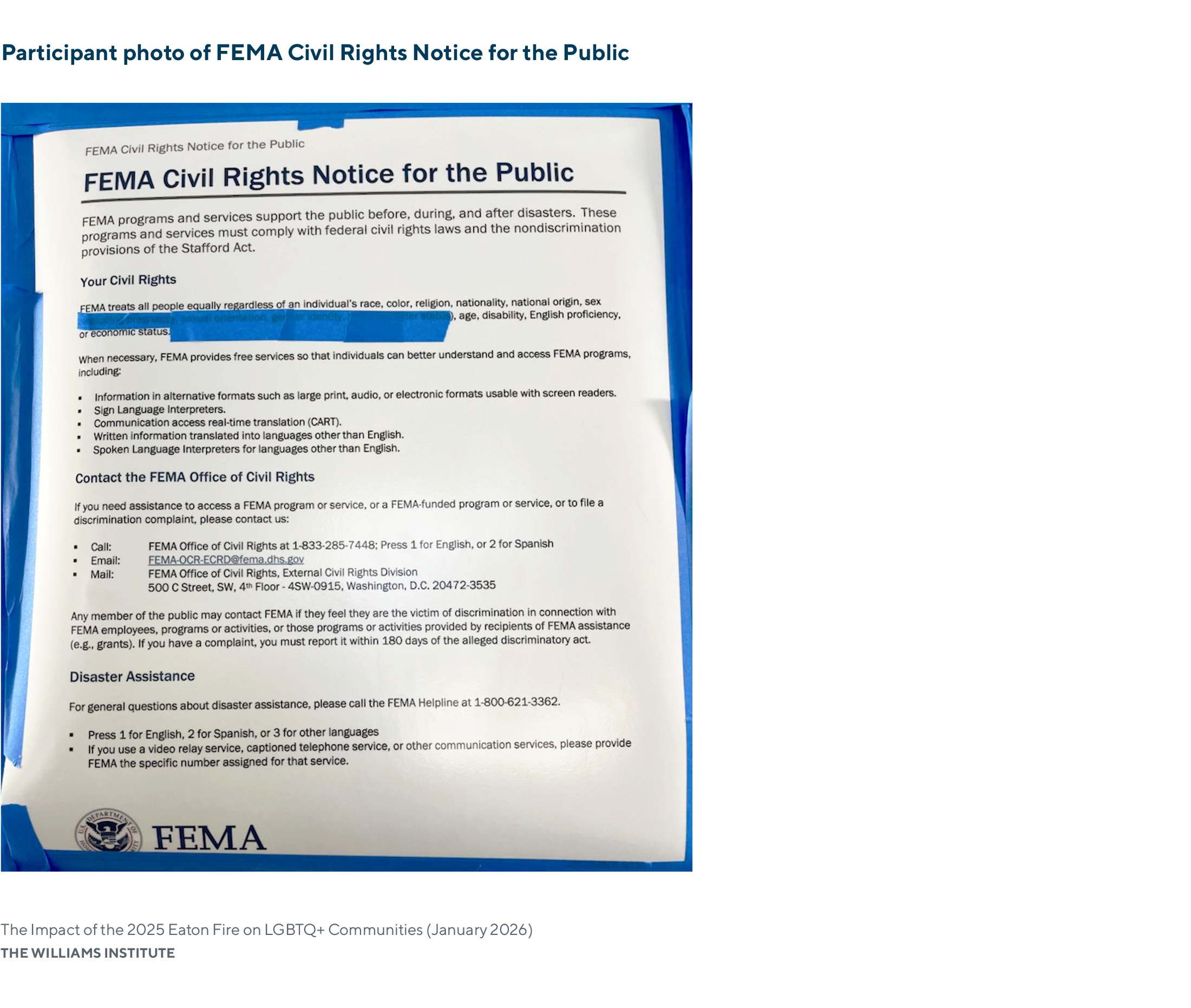
Source: Listening session participant, May 7, 2025, Altadena, California
These experiences of bias were reinforced and often magnified by broader institutional barriers across formal disaster response systems, including FEMA, insurance companies, aid organizations, and local governments. Participants widely described the FEMA application process as confusing, rigid, and overwhelming, with “brutal” deadlines that did not account for trauma, displacement, caregiving responsibilities, or disability. The rapid needs assessment data reflect these challenges: more than half of LGBTQ+ respondents (51%) reported feeling overwhelmed by the volume of information provided, and about one-third (32%) reported not knowing what services were available. Participants from the listening sessions reported long delays in disbursement of aid funds, contradictory guidance from staff, and eligibility decisions that felt arbitrary or opaque. Some shared that, after investing significant time in applications, they were ultimately told they did not qualify, while others chose not to apply because the process seemed impossible to navigate.
Faith-based agencies also created barriers, with some LGBTQ+ survivors encountering requirements to participate in religious activities to obtain essentials like water. These experiences felt conditional and exclusionary, and heightened fears of mistreatment.
Beyond these barriers, transgender and nonbinary participants expressed concern about potential challenges tied to mismatched gender markers on identification documents and fear that disclosing their gender identity could expose them to further mistreatment. One participant stated: “In the middle of this, I had to get my driver’s license renewed. I needed it to work with FEMA, but I wasn’t sure if I should start using my deadname and sex assigned at birth again or get my license renewed with my real name and gender. Would I be putting myself at risk if my state ID doesn’t match my federal ID?” These dynamics highlight how the design and implementation of disaster relief systems can place LGBTQ+ people, especially transgender and gender nonconforming people, in positions where accessing help requires difficult tradeoffs between safety, privacy, and recovery.
LGBTQ+ Survivors Experienced Intersectional Inequities by Race, Class, and Housing Status
LGBTQ+ survivors who were also people of color, living with low incomes, or renters described compounding inequities that shaped nearly every aspect of their recovery. Listening session participants from historically Black neighborhoods reported unequal protections during the disaster, including needing to call repeatedly for patrols to prevent looting, while perceiving that predominantly White areas received quicker or more consistent attention. Others described being treated as potential trespassers when attempting to re-enter their own homes. Spanish-speaking LGBTQ+ participants also encountered significant language barriers at resource centers and aid agencies, which often lacked bilingual staff, leaving them uncertain about their eligibility for programs, re-entry procedures, or available aid.
These inequities were intensified by economic and housing status disparities. Rapid needs assessment survey data showed that LGBTQ+ respondents were more likely than non-LGBTQ+ respondents to be renters; listening session participants who were renters consistently felt overlooked in a recovery process that prioritized homeowners. Participants reported inconsistent guidance, limited legal protections, and, in some cases, being turned away from disaster resource centers despite experiencing total losses. Rising rental costs after the Eaton Fire further displaced many LGBTQ+ renters, threatening the long-term survival of LGBTQ+ communities in the affected areas. LGBTQ+ participants living on low incomes also described difficulties taking time off work to complete FEMA paperwork and insurance claims, with many worrying about slipping into homelessness as assistance has expired and return costs have mounted. Rapid needs assessment survey data showed that one-fifth of LGBTQ+ respondents (19%) reported needing help finding work after the fire. These intersecting inequities illustrate how existing socioeconomic disparities shaped the pace, accessibility, and feasibility of recovery for LGBTQ+ survivors.
Community-Based Support Filled Recovery Gaps for LGBTQ+ Survivors
Given these shortcomings, LGBTQ+ survivors overwhelmingly relied on mutual aid networks, family, friends, and community-based organizations as their most trusted sources of support. Results from the rapid needs assessment survey show that more than 40% of LGBTQ+ respondents considered their community groups and organizations the most helpful source of support. LGBTQ+ community groups mobilized quickly, disseminating reliable information, distributing supplies, organizing housing resources, and providing emotional support. Yet this reliance came with substantial costs: many LGBTQ+ survivors were also frontline workers at nonprofits, clinics, or community organizations, resulting in significant burnout by September as they struggled to help others while managing their own recovery.
LGBTQ+ Survivors Recommendations for Recovery Support Systems
Listening session participants offered robust guidance for improving disaster systems for the current recovery process and for future disasters. Participants’ recommendations for the present crisis highlighted urgent needs:
- Rebuild and preserve LGBTQ+ community spaces lost to the fire.
- Intentionally include LGBTQ+ residents in post-disaster planning and rebuilding.
- Ensure displaced residents can return.
To support future disaster responses that are inclusive of LGBTQ+ survivors’ needs, participants emphasized additional needs:
- Centralized and trustworthy resource hubs amidst disasters
- Inclusion of existing LGBTQ+ community organizations and service providers in recovery efforts
- Provision of direct assistance to navigate forms, deadlines, and available services
- Development of community-focused spaces specifically for LGBTQ+ gathering, mourning, healing, and care
- Resources to address the vulnerabilities of renters and to prioritize them alongside homeowners
- Focused attention, resources, and support for those who live alone or may lack support from immediate family members
- Confidential, low-barrier, stigma-free mental health services for individuals and communities
- Broader disaster literature that reinforces these priorities and adds that the inclusion of sexual orientation and gender identity data collection is imperative for conducting research to inform disaster preparedness systems and programs for LGBTQ+ people specifically.
Ultimately, findings reveal that the most consequential harms LGBTQ+ survivors faced were not caused by the fire alone, but by the systems layered on top of the disaster: housing markets, policing, insurance processes, aid systems, and widespread discrimination. Addressing these challenges requires equity-centered, trauma-informed, and LGBTQ-inclusive disaster response strategies that reflect the lived experiences of the communities most affected.
Download the full report