Executive Summary
This report focuses on LBTQ Latinas living in Los Angeles County because they are a critical part of LA’s past, present, and future. Latinas are the largest group of women in Los Angeles County, comprising almost half of the women and girls who live in LA. Los Angeles County has the largest Latina population of any county in the United States by far, including almost 1.5 million Latina adults aged 18 years and older. LBTQ identification is growing among Latinas in Los Angeles County and California, particularly among those who are younger and identify as bisexual. Latinas, including LBTQ Latinas, are civically engaged and helping to shape the political and cultural direction of Los Angeles. However, Latinas in Los Angeles County also face overlapping barriers based on their sex, sexual orientation, gender identity, race, ethnicity, immigration status, and other characteristics. Understanding and supporting the future of Los Angeles requires a deeper understanding of the challenges that LBTQ Latinas face and the contributions they are making, and will continue to make, to Los Angeles.
An estimated 106,000 LBTQ Latinas aged 18 and older live in Los Angeles County. This report presents information about the experiences of LBTQ Latinas with discrimination and harassment in various areas, including employment, housing, healthcare, public spaces, and law enforcement, as well as findings regarding their health and economic well-being.
This report uses representative data collected from 1,006 LGBTQ Los Angelenos who completed the Los Angeles County Department of Public Health’s 2023 Los Angeles County Health Survey (LACHS) and 504 LGBTQ Angelenos who also completed the Lived Experiences in Los Angeles County (LELAC) Survey, which was a call-back study to LACHS developed by the Williams Institute. Overall, respondents were diverse in terms of sexual orientation, gender identity, race, age, income, and other demographic characteristics, reflecting the diversity of Los Angeles County’s LGBTQ population. The LACHS survey respondents included 136 LBTQ Latinas, of whom 68 responded to the LELAC follow-up survey.
As described more fully in the Background section below, to contextualize their experiences, we primarily compare LBTQ Latinas to the following six groups in Los Angeles County: non-LBTQ Latinas, GBTQ Latinos, LBTQ White women, GBTQ White men, non-GBTQ White men, and all adults in Los Angeles County. In a few instances, comparisons are made to all LGBTQ adults in Los Angeles County. While data for all of these groups are presented in the Appendix tables, in the text of the report, we focus on presenting findings that are statistically significant, unless otherwise noted.
LBTQ Latinas make up at least 16% of Los Angeles County’s LGBTQ adult population, and over 7% of all Latinas in Los Angeles County identify as LBTQ. The majority are under the age of 34, cisgender, bisexual, and live in Supervisorial Districts 1 and 4. Over one in 10 are not U.S. citizens. Several main themes emerged from the analyses presented in this report:
- Affording life in Los Angeles. Los Angeles County’s historic promise of equality and freedom for LGBTQ adults is being undermined by the rapidly escalating cost of living. More than half (53%) of LBTQ Latinas live in households with incomes below 200% of the federal poverty level (FPL), 51% experienced food insecurity in the past year, and 72% were housing cost burdened. Being able to afford living in Los Angeles County was the most common worry among LBTQ Latinas, and it was the primary issue they would like elected officials to address. As the county’s leaders work to address the housing crisis and other economic issues, they must consider the specific challenges faced by LBTQ Latinas.
- Challenges in building families and receiving social support. Like all LGBTQ people, most LBTQ Latinas are not born into LGBTQ families and communities that pass on LGBTQ community networks, culture, support, and coping mechanisms. Instead, many LBTQ Latinas in Los Angeles County were not out to all their friends and families, faced unique challenges in having children, faced racial discrimination within LGBTQ communities, and were isolated from their religious and spiritual communities. LBTQ Latinas over the age of 50 were twice as likely to feel lonely as all adults in Los Angeles County. Almost three-fourths of LBTQ Latinas under the age of 50 said they wanted to have children, although they identified many barriers to doing so, including economic vulnerability. Policy solutions for LBTQ Latinas must address these unique challenges to building families and communities.
- Safety concerns. Many LBTQ Latinas in Los Angeles County shaped their daily lives around protecting their safety. Only half of the respondents reported feeling safe in their neighborhood either all or most of the time. Furthermore, over one in four reported being verbally harassed by strangers on the street, and one in five reported having been verbally harassed by strangers while visiting an LGBTQ event or organization. In an effort to protect themselves, many chose to avoid public transportation, parks, and beaches; refrained from frequenting LGBTQ-related businesses; and did not attend or participate in Pride festivals or similar events. Additionally, many LBTQ Latinas expressed the need for policies that protect the safety of themselves and their families.
- Ongoing discrimination and harassment. Even with supportive state and local laws in place, many LBTQ Latinas in Los Angeles County continued to experience discrimination and harassment in employment, housing, and health care. Over half were not out to their supervisors at work; one in five reported that a landlord or realtor in Los Angeles County had refused to sell or rent to them because of their LBTQ identity; and over one in seven reported receiving inferior services when accessing health care because of their LBTQ identity. These findings confirm that equality “on the books” does not always translate to equality in lived experience, highlighting the limits of legal protections without active enforcement and cultural change. Local protections need to be strengthened and backed with consistent enforcement, training, and monitoring for compliance.
- Resultant health disparities. As a result of their lived experiences, LBTQ Latinas in Los Angeles County had higher rates of mental health issues, substance use issues, intimate partner violence, and disabilities than non-LBTQ Latinas and adults overall in Los Angeles County. These health conditions were exacerbated by discriminatory treatment from health care providers, leading many LBTQ Latinas to avoid care or not to disclose their LBTQ identity to their providers, resulting in poorer health. Improving the health of LBTQ Latinas will require initiatives specifically tailored to their unique health concerns, ongoing training for providers, effective civil rights enforcement, and targeted community education.
- Communities of resilience. Despite the challenges, most LBTQ Latinas agreed that Los Angeles County was a good place for LGBTQ people to live. They celebrated the many ways that LGBTQ people contributed to the unique identity of Los Angeles, including by serving as models for others to be strong, love, and live their lives authentically; enriching the county’s diversity; and engaging in advocacy and volunteer work on behalf of many communities. While facing numerous challenges, many LBTQ Latinas are already working alongside elected officials and others to make Los Angeles County a better place not only for LBTQ Latinas but for everyone. Their main message to local elected officials is to accept them, seek and include their input in policy discussions, and to work with them as strong and visible allies.
Considerations for Programs and Services Providers
The findings of this report indicate that in order to effectively address the needs of LBTQ Latinas, services and programs in Los Angeles County must center around LBTQ Latinas. One of the clearest themes that emerged from this analysis is that the multiple forms of marginalization faced by LBTQ Latinas create unique needs that will not be addressed in programs that center around other parts of the LGBTQ community. For example:
- Location matters. Attention should be paid to the location of programs and services for LBTQ Latinas. LBTQ Latinas were concentrated in Supervisorial Districts 4 (29%) and 1 (25%). While 32% of LGBTQ adults in Los Angeles County lived in District 3, which includes West Hollywood and other historic LGBTQ neighborhoods, only 21% of LBTQ Latinas lived in District 3. Notably, GBTQ White men were twice as likely to live in District 3 as LBTQ Latinas (44% vs. 21%). On the other hand, LBTQ Latinas might face challenges in the placement of services in their neighborhoods. While just over half of LBTQ Latinas (53%) felt safe all or most of the time in their neighborhoods, 89% of GBTQ White men felt that way.
- Programs must be accessible to those who are younger and who identify as bisexual. Services for LBTQ Latinas need to be geared towards those who are younger, and they must address biphobia and bisexual erasure. More than six in 10 LBTQ Latinas (63%) were between the ages of 18 and 34 years compared with 36% of non-LBTQ Latinas and 22% of GBTQ White men. Two-thirds of LBTQ Latinas in Los Angeles County identified as cisgender bisexual women (67%) compared with 33% of GBTQ Latinos and 18% of GBTQ White men who identified as cisgender bisexual men.
- Faith-based providers should be welcoming. LBTQ Latinas were twice as likely as GBTQ White men to indicate that they were part of a religious or spiritual community (68% vs. 34%) and were over twice as likely to not be out to anyone in their community of faith (65% vs. 28%). Many LBTQ Latinas avoided religious services out of fear of unfair treatment, which could create complexities for services provided by faith-based organizations. Faith-based service providers must be open and affirming to LBTQ Latinas. Government contracts with these providers should include requirements to ensure effective services for LBTQ Latinas.
- Intracommunity bias and discrimination should be addressed. Effective services for LBTQ Latinas should address racism within LGBTQ communities; homophobia in Latinx communities; and sexism, transphobia, and biphobia that exist in both communities.
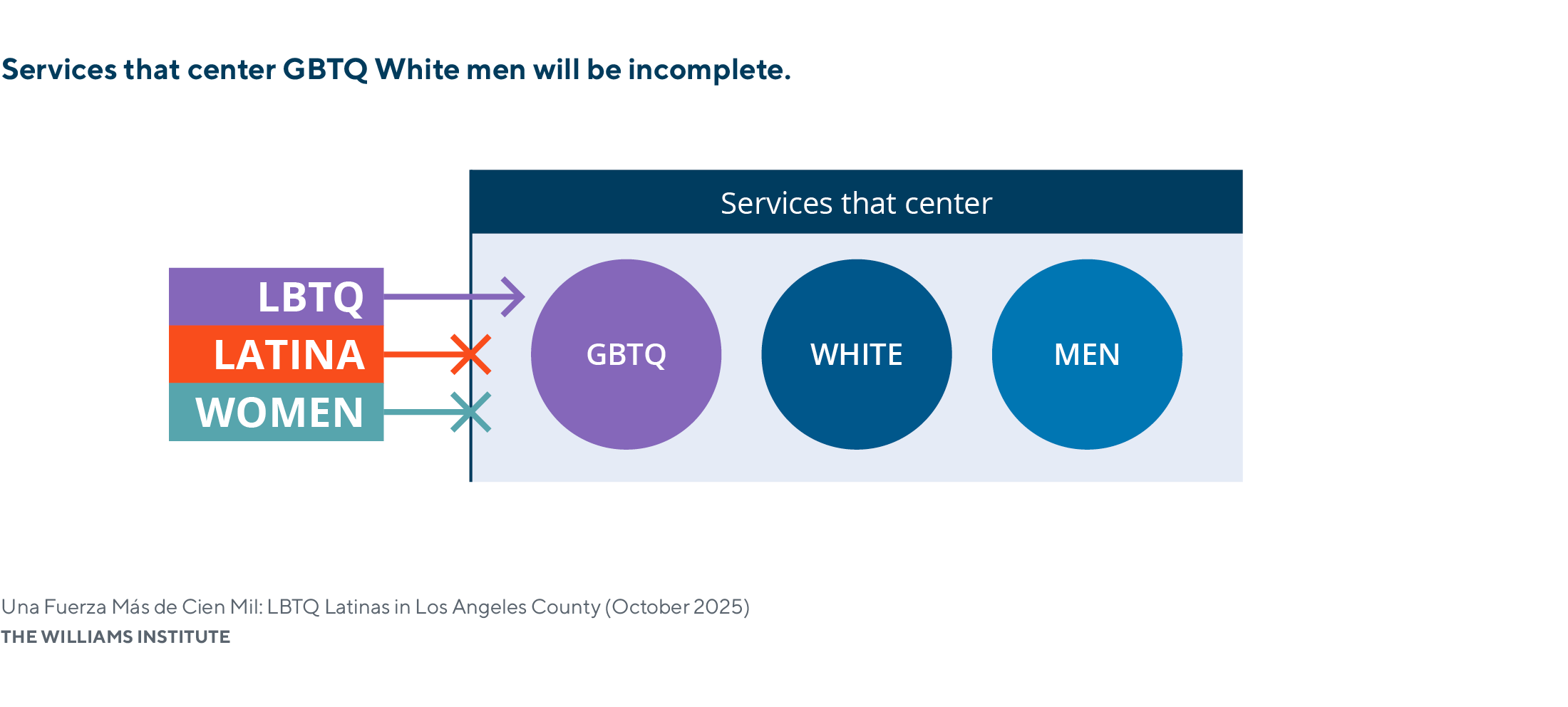
Historically, better-resourced LGBTQ services and organizations have centered White GBTQ men in the United States and Los Angeles, often to the exclusion of people of color and women, including LBTQ Latinas. Nationally, in 2023, only 37% of all U.S. foundation funding for domestic LGBTQ communities and causes supported LGBTQ communities of color, and only 6% supported Latinx LGBTQ communities.
Services and programs that center the experiences of GBTQ White men in Los Angeles County may not fully account for the economic, health, and other challenges faced by many LBTQ Latinas. Here are some key examples:
- In terms of having a college degree or more, only 35% of LBTQ Latinas had a degree, compared with 62% of GBTQ White men.
- LBTQ Latinas had higher rates of living in households with incomes of 200% or below the FPL (53% vs. 21%), that are housing cost-burdened (72% vs. 50%), and that have experienced food insecurity in the past year (51% vs. 16%) than GBTQ White men.
- LBTQ Latinas were also over five times as likely to have been unhoused at some time in the past five years (16% vs. 3%) and were less likely to be homeowners (29% vs. 49%) than GBTQ White men.
- Further, almost half (48%) of LBTQ Latinas met the CDC’s definition of obesity, compared with 19% of GBTQ White men.
- Research indicates that supportive parenting and family formation services are crucial for the well-being of LBTQ Latinas. LBTQ Latinas under the age of 50 were over twice as likely to say they wanted to have children as GBTQ White men of the same age (74% vs. 33%). Furthermore, services would need to address different barriers to parenting. For example, LBTQ Latinas were much less likely to identify not having a partner or spouse as a barrier to having children than GBTQ White men (15% vs. 58%).
- LBTQ Latinas in Los Angeles County were much more likely to be non-citizens than GBTQ White men (13% vs. 2%). When gearing services towards LBTQ Latinas, providers should keep in mind that 20% are foreign-born and that, regardless of citizenship status, they may face unique challenges, including language barriers and cultural barriers. Some LBTQ Latinas lack the required immigration status or documentation for eligibility for services, experiencing additional barriers. In a climate of increased levels of detention and deportation, they may also experience fear and/or mistrust toward institutions that could support them, their families, and their loved ones.
- Further, levels of openness or outness about one’s LGBTQ identity differ greatly between LBTQ Latinas and GBTQ White men. LBTQ Latinas are far less likely to be out to all of their immediate family members (45% vs. 75%) and all of their health care providers (31% vs. 74%) than GBTQ White men. Programs and services that assume family support or the sharing of household resources should consider the unique needs of LBTQ Latinas to ensure equitable access and effective support. Health care providers and services should consider that many LBTQ Latinas, particularly those who are bisexual, might not be out when accessing health care services.
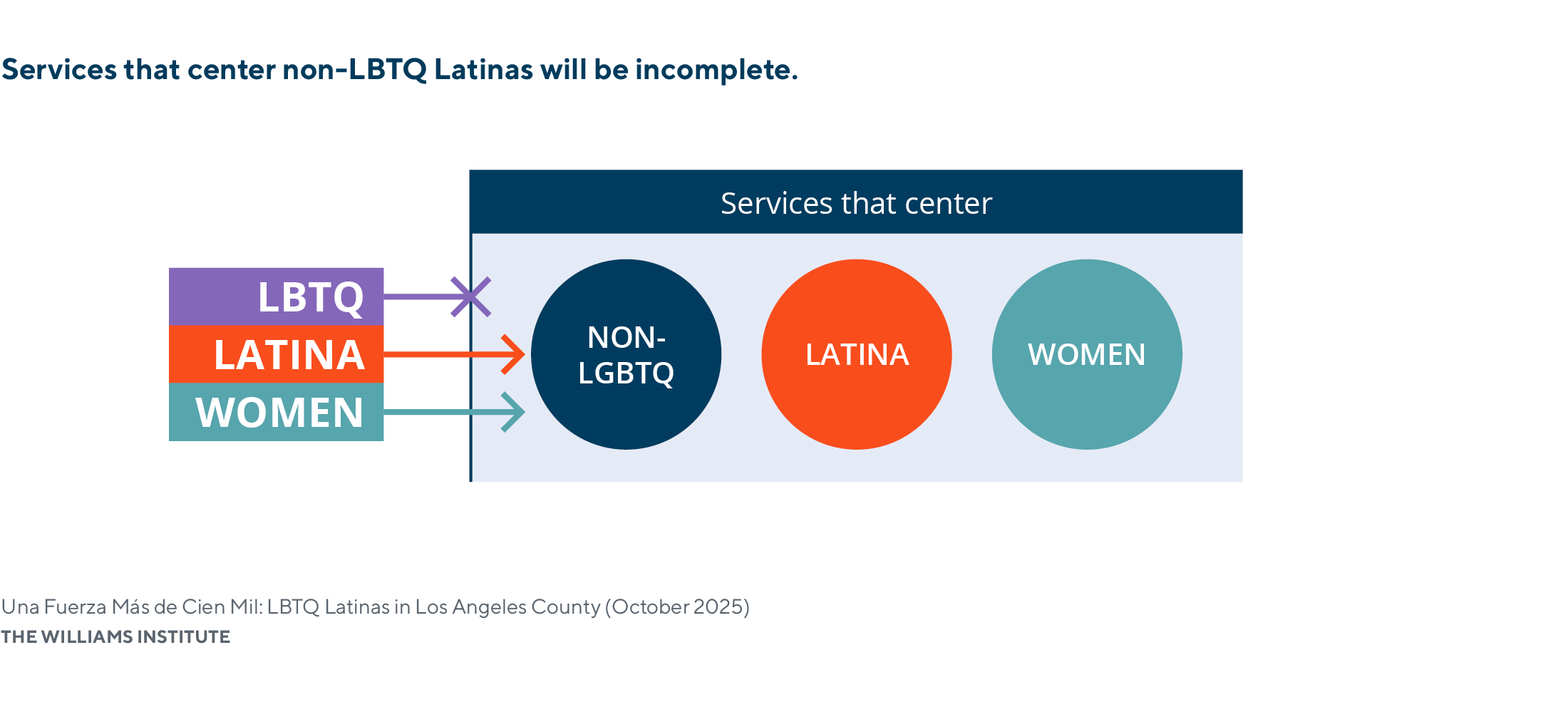
Services and programs that center non-LBTQ Latinas may not account for health disparities and other issues faced by LBTQ Latinas. For example:
- LBTQ Latinas were more than twice as likely to report symptoms of depression (23% vs. 11%), loneliness (45% vs. 22%), suicide attempts (24% vs. 4%), binge drinking (47% vs. 17%), heavy marijuana use (21% vs. 3%), and intimate partner violence (49% vs. 22%) as non-LBTQ Latinas.
- LBTQ Latinas were also much more likely to report living with a disability (53% vs. 29%); living in a household experiencing food insecurity (51% vs. 35%); and having been unhoused at some point in the past five years (16% vs. 6%) than non-LBTQ Latinas.
- LBTQ Latinas were also less likely to be currently married or in a domestic partnership compared to non-LBTQ Latinas (29% vs. 45%).
- LBTQ Latinas were more likely to be U.S.-born citizens than non-LBTQ Latinas (80% v. 61%).
- In terms of education, 35% of LBTQ Latinas had a college degree or more, compared with only 21% of non-LBTQ Latinas.
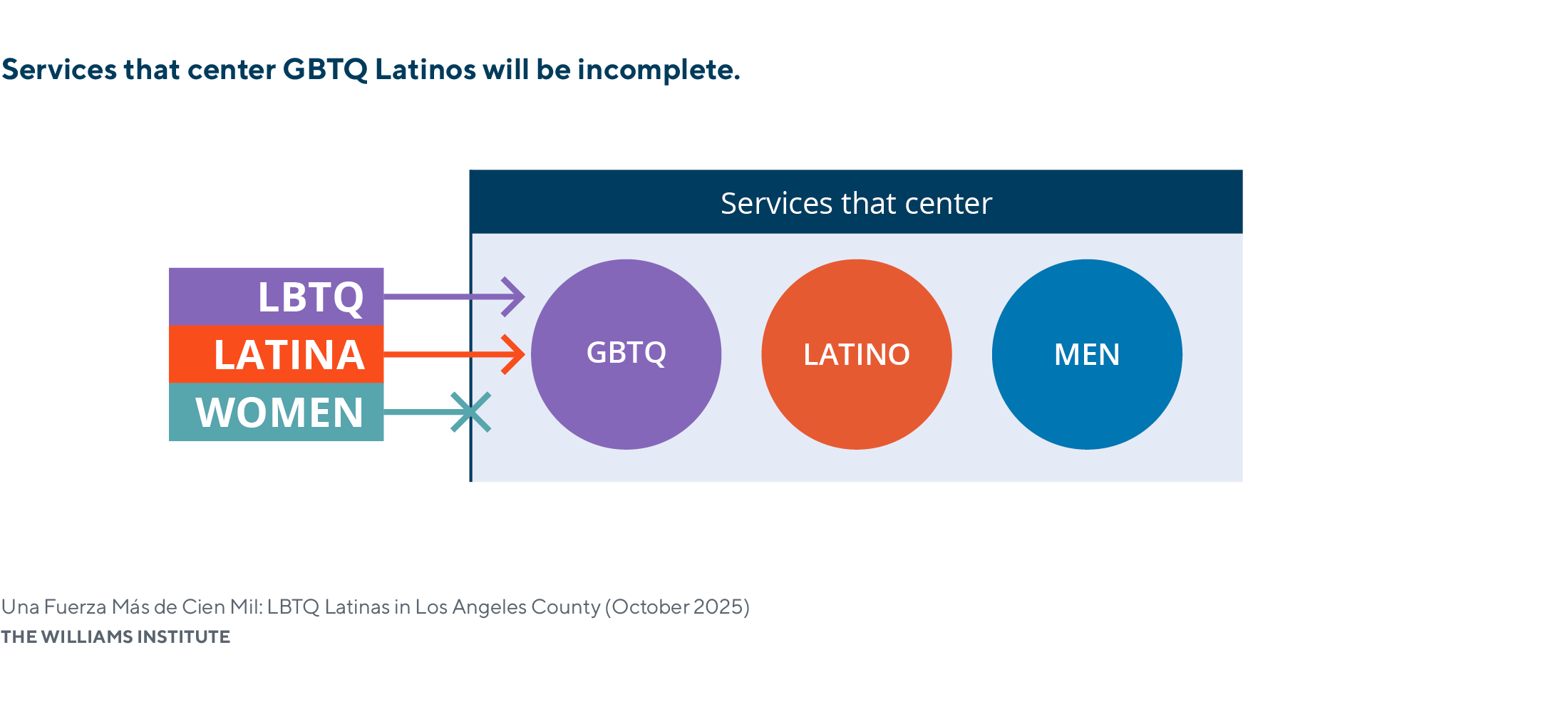
Similarly, programs that focus on GBTQ Latinos may not fully address the needs of LBTQ Latinas. For example:
- Two-thirds of LBTQ Latinas (67%) identified as cisgender bisexual women while only 33% of GBTQ Latinos identified as cisgender bisexual men.
- LBTQ Latinas were also much more likely to report suicide attempts (24% vs. 6%) and intimate partner violence (49% vs. 27%) than GBTQ Latinos.
Key Findings
Demographics
- There are approximately 106,000 LBTQ Latina adults living in Los Angeles County.
- By Supervisorial District, over half of LBTQ Latinas lived in District 4 (29%) and District 1 (25%).
- LBTQ Latinas are a younger population. More than six in 10 LBTQ Latina adults (63%) were between the ages of 18 and 34 years compared with 36% of non-LBTQ Latinas, 32% of LBTQ White women, 22% of GBTQ White men, and 18% of non-GBTQ White men.
- Most (96%) LBTQ Latina adults were cisgender, and 4% were transgender.
- Sixty-seven percent of LBTQ Latina adults in Los Angeles County identified as cisgender bisexual women and 29% as cisgender lesbians.
- LBTQ Latinas were almost twice as likely to identify as cisgender bisexual women (67%) as GBTQ Latinos were to identify as cisgender bisexual men (33%).
- Most LBTQ Latina adults (80%) were U.S.-born citizens, 7% were naturalized citizens, and 13% were not U.S. citizens.
- LBTQ Latinas were more likely to be U.S.-born citizens than non-LBTQ Latinas (80% v. 61%).
- LBTQ Latinas were much more likely to be non-citizens (neither U.S.-born nor naturalized citizens) than LBTQ White women (less than 2%) and GBTQ White men (2%) in Los Angeles County.
- Over half of LBTQ Latinas (53%) met the criteria used by the U.S. Census Bureau to assess disability. This was over double the rate of disability for non-GBTQ White men (22%) in Los Angeles County.
Climate in Los Angeles County
- Most LBTQ Latinas felt that “Los Angeles County is a good place for LGBTQ people to live,” with 81% somewhat or strongly agreeing with that statement.
- When asked more specifically about acceptance of LGBTQ people in the neighborhood where they lived, almost one in four LBTQ Latinas (24%) indicated there was only “a little” acceptance or “none.”
- While not statistically significant, this was higher than GBTQ Latinos (13%), GBTQ White men (7%), and LBTQ White women (5%).
Joys, Worries, and Contributions to Los Angeles of LBTQ Latinas
- When asked about their biggest sources of joy, LBTQ Latinas emphasized family, friends, and pets; exercising and being outside; listening to and making music; and cooking and enjoying food.
- When asked about their biggest sources of worry, LBTQ Latinas emphasized concerns about meeting the high cost of living in Los Angeles County; their relationships and caregiving for friends, family, and pets; their health; and their jobs.
- In terms of what LGBTQ people contributed to Los Angeles County, the types of contributions identified by LBTQ Latinas fell into four primary areas:
- Positive values and characteristics. Fifty-four percent of LBTQ Latinas identified specific positive values and characteristics that LGBTQ people share not only with the LGBTQ community but also more broadly. Examples included acceptance and tolerance, compassion and support, inspiring everyone to be their authentic selves, love, joy, vibrancy and spirit, a strong sense of community, and a belief in equality.
- Enriching diversity. Twenty-eight percent of LBTQ Latinas wrote about how LGBTQ people and communities added to the county’s rich diversity, including by being role models for LGBTQ people who were not yet out and helping to educate non-LGBTQ people about LGBTQ communities.
- Community leadership and service. One in four LBTQ Latinas (25%) discussed the community service and activism that LGBTQ people provide to LGBTQ communities and to other marginalized communities.
- Culture, arts, and creativity. Finally, 13% wrote about how LGBTQ people’s creativity contributes to the arts, culture, and entertainment in Los Angeles.
- LBTQ Latinas reported high levels of civic engagement, with 74% reporting at least one form of civic engagement in the past year. In the past year:
- Approximately half (53%) of LBTQ Latinas reported posting or responding to social media posts about social issues.
- Four in 10 reported signing a petition (40%) or donating money to community organizations or causes (39%).
- Approximately one in five reported volunteering with a community group or organization (22%) or contacting a public official to express their feelings about a particular issue (17%).
- Approximately one in 10 (11%) reported joining a march or demonstration, and 8% reported working on a political campaign in the past two years.
Recommendations for Elected Officials
When asked for suggestions about how local elected officials could improve the quality of life for LGBTQ people in Los Angeles County, LBTQ Latinas focused on five main themes:
- Elected officials engaging more effectively with LGBTQ communities through acceptance and support of LGBTQ people; listening and incorporating their input; and public and visible allyship;
- Increasing resources and awareness for services, programs, and events for LGBTQ communities;
- Protecting the safety of LGBTQ communities;
- Creating more affordable and safe housing, health care, and educational opportunities; and
- Protecting the legal rights and equality of LGBTQ people.
When asked separately about how elected officials could support LGBTQ people with family formation, LBTQ Latinas recommended that they:
- Provide more support and resources;
- Affirm LGBTQ families and provide them with equal parenting rights;
- Make adoption, foster care, and assisted reproductive technology (ART), including in vitro fertilization (IVF), easier and more affordable;
- Make school systems safer and more welcoming for LGBTQ students and parents; and
- Increase support for paid family leave and childcare.
Family and Friends
- Less than half (45%) of LBTQ Latinas were out to all their immediate family.
- LBTQ Latinas (45%) were less likely to be out to all of their immediate family members than GBTQ White men (75%).
- Similarly, only 46% reported being out to all of their non-LGBTQ friends.
- Twenty-nine percent of LBTQ Latinas were currently married or in a domestic partnership compared with 45% of non-LBTQ Latinas.
- Almost half (47%) of LBTQ Latinas over age 50 were living alone, compared to 22% of all adults in Los Angeles County.
- Based on the UCLA Loneliness Scale, 45% of LBTQ Latinas in Los Angeles County were lonely, compared with 26% of all adults in Los Angeles County, 22% of non-LBTQ Latinas, and 20% of non-GBTQ White men.
- In terms of getting the emotional support they needed, 50% of LBTQ Latinas in Los Angeles County felt they always or usually received the support they needed.
- In comparison, 73% of non-GBTQ White men in Los Angeles County felt they always or usually received the support they needed.
- Fifteen percent of LBTQ Latinas were parents, similar to LGBTQ adults in Los Angeles County overall (18%).
- LBTQ Latinas had become parents through a variety of pathways: 70% of those with children had biological children, 2% had stepchildren, and 21% had adopted and/or fostered children.
- Almost three-fourths (74%) of LBTQ Latinas under the age of 50 said they wanted to have children, including some who already had at least one child.
- LBTQ Latinas under the age of 50 were over twice as likely to say they wanted to have children compared to GBTQ White men (74% vs. 33%).
- Among LBTQ Latinas who wanted a child, 68% were considering intercourse, 52% were considering adoption, 41% were considering ART, and 31% were considering fostering a child as a path to parenthood.
- However, when asked about their preferred method for having a child, only 10% preferred adoption or fostering, with the others preferring intercourse (59%) or ART (31%). Most LBTQ Latinas (59%) felt that their preferred method for having a child was not at all likely or only somewhat likely, identifying cost (27%), not having a partner or spouse (15%), and fertility problems (13%) as key barriers.
LGBTQ Communities and Spaces
- One in five LBTQ Latinas (20%) reported having been verbally harassed by strangers while attending an LGBTQ event (like a Pride parade or a festival) or visiting an LGBTQ organization, community center, theater, restaurant, or business in LA.
- Due to fears of being assaulted or attacked because of their LGBTQ status, 11% of LBTQ Latinas in the county had avoided LGBTQ bars, nightclubs, or events during the past year, and 8% had avoided LGBTQ organizations or businesses.
- Several LBTQ Latinas shared experiences of racism within LGBTQ communities or spaces.
Religious and Spiritual Communities
- Two-thirds (68%) of LBTQ Latinas identified as a spiritual person, and 20% identified as a religious person.
- Over half (53%) of LBTQ Latinas in Los Angeles County indicated that religion was very or somewhat important in their lives.
- Although not statistically significant, LBTQ Latinas (19%) were more likely to report attending religious services at least once a month than GBTQ Latinos (10%), White LGBTQ women (8%), and men (7%).
- While over two-thirds (68%) of LBTQ Latinas in Los Angeles County indicated that they were part of a spiritual or religious community, the majority of them (65%) were not out to anyone in that community, and only 21% were out to everyone.
- LBTQ Latinas were twice as likely to indicate that they were part of a religious or spiritual community than GBTQ White men in Los Angeles County (68% vs. 34%), but those who were, were also over twice as likely to not be out to anyone in that community compared to GBTQ White men (65% vs. 28%).
- Almost one in four LBTQ Latinas reported that they avoided religious or spiritual practices to avoid unfair treatment (23%) or to avoid being threatened or physically attacked (23%) because of their LBTQ identity in the past year.
Employment
- Almost seven in 10 (69%) LBTQ Latinas in Los Angeles County were employed, 15% were unemployed but looking for work, and 17% were not in the workforce.
- Of employed LBTQ Latinas, over half (52%) were not out to their supervisor, and over one-third (37%) were not out to any of their coworkers.
- Over one in eight (13%) LBTQ Latinas reported being fired or not promoted at work within the past five years because of their sexual orientation or gender identity while living in Los Angeles County.
- Similarly, over one in eight (14%) LBTQ Latinas reported not being hired for a job within the past five years because of their sexual orientation or gender identity while living in Los Angeles County.
- One in seven (14%) LBTQ Latinas reported that they had been verbally harassed by their supervisor or coworkers during their careers based on their sexual orientation, gender identity, or gender expression while working in Los Angeles County. A similar percentage (16%) reported having been verbally harassed by customers or clients.
Public Spaces and Safety
- Just over half (53%) of LBTQ Latinas felt safe all or most of the time in the neighborhood where they lived. In contrast, 89% of GBTQ White men felt safe all or most of the time in their neighborhoods.
- Thirty-three percent of LBTQ Latinas who have lived their entire lives in Los Angeles County reported that they had been a victim of a personal crime at least once in their lifetime, and 43% reported that they had been a victim of a property crime.
- Over one in four (28%) LBTQ Latinas reported being verbally harassed by strangers on the street. Eighty percent had their most recent experience in the past five years.
- Over one in five (22%) LBTQ Latinas reported avoiding restaurants and stores in Los Angeles County in the past year due to concerns about being threatened or physically attacked because of their LBTQ identity, and approximately one in 10 had avoided going to public parks or beaches (13%) and using public transportation (10%) for the same reasons.
- Some LBTQ Latinas reported having had negative interactions with police and law enforcement in Los Angeles County, including verbal harassment (12%), physical harassment (5%), sexual harassment (5%), and being solicited for sex (4%).
Economic Disparities
- Education. Thirty-five percent of LBTQ Latinas had a college degree or more compared with 21% of non-LBTQ Latinas, 61% of LBTQ White women, 62% of GBTQ White men, and 50% of non-GBTQ White men.
- LBTQ Latinas were twice as likely to have a four-year college degree as non-LBTQ Latinas (28% vs. 13%).
- While they had similar rates (7%) of having graduate degrees as non-LBTQ Latinas (8%) and GBTQ Latinos (11%), they were significantly less likely to have a graduate degree than LBTQ White women (26%), GBTQ White men (30%), and non-GBTQ White men (20%).
- Household Income. Approximately one in four (23%) LBTQ Latinas in Los Angeles County were in households living on less than 100% of the Federal Poverty Level (FPL), and over half (53%) were living on less than 200% of the FPL.
- LBTQ Latinas (53%) were over twice as likely to be living in households with incomes below 200% of the FPL than LBTQ White women (23%) and GBTQ White men (21%). They were three times as likely to be living in such households as non-GBTQ White men (14%).
- Food Insecurity. Over half of LBTQ Latinas in Los Angeles County (51%) lived in households that met criteria for food insecurity in the past 12 months.
- This was twice the rate of food insecurity for all adults in Los Angeles County (25%) and higher than the rate for non-LBTQ Latinas (35%), LBTQ White women (19%), GBTQ White men (16%), and non-GBTQ White men (11%).
- Housing
- Almost two-thirds (64%) of LBTQ Latinas in Los Angeles County were renters.
- LBTQ Latinas (29%) had a much lower rate of home ownership than GBTQ White men (49%) and non-GBTQ White men (63%) in Los Angeles County.
- Almost three-fourths (72%) of LBTQ Latinas lived in households that were housing cost-burdened, spending 30% or more of their household income on housing, compared with 54% of adults overall in Los Angeles County.
- Over twice as many LBTQ Latinas (32%) were severely housing cost-burdened (spending over 50% of their household income on housing) compared to GBTQ (15%) and non-GBTQ (12%) White men.
Health Disparities
- Almost one in four (23%) LBTQ Latinas reported symptoms that indicated that they were at major risk of depression.
- Symptoms of depression were over twice as common among LBTQ Latinas than among all adults in Los Angeles County (11%), non-LBTQ Latinas (11%), and non-GBTQ White men (7%).
- Almost one in four (24%) LBTQ Latinas attempted suicide at some point in their lives.
- LBTQ Latinas were much more likely to report a suicide attempt than all adults in Los Angeles County (4%), non-GBTQ White men (3%), non-LBTQ Latinas (4%), and GBTQ Latinos (6%).
- While almost half (46%) of LBTQ Latinas had received mental health care in the past 12 months, about one in four (25%) expressed an unmet need for care.
- Over twice as many LBTQ Latinas (49%) as adults overall in Los Angeles County (19%) reported experiencing intimate partner violence (IPV) at some point in their lives.
- LBTQ Latinas were more likely to report IPV than non-LBTQ Latinas (22%), GBTQ Latinos (27%), and non-GBTQ White men (17%).
- Almost half (47%) of LBTQ Latinas reported binge drinking in the prior month compared to 22% of adults overall in Los Angeles County, 17% of non-LBTQ Latinas, and 22% of non-GBTQ White men.
- Twenty-one percent of LBTQ Latinas reported heavy marijuana use (meaning daily or near daily use in the prior month), three times more frequently than adults overall in Los Angeles (6%) and seven times more frequently than non-LBTQ Latinas (3%).
- Two-thirds (67%) of LBTQ Latinas met the CDC’s definition of being overweight or obese, with almost half (48%) meeting the CDC’s definition of obesity.
- LBTQ Latinas (48%) were more likely to be living with obesity than adults overall in Los Angeles County (30%), including LBTQ White women (24%), GBTQ White men (19%), and non-GBTQ White men (23%).
- Forty-one percent of LBTQ Latinas reported difficulty in accessing medical care, compared to 25% of all adults in Los Angeles and 15% of non-GBTQ White men.
- While accessing health care services in Los Angeles County, 18% of LBTQ Latinas reported having been verbally harassed, and 16% reported that they had been denied care or provided with inferior care, because of their sexual orientation or gender identity, while living in Los Angeles County. Three-fourths of LBTQ Latinas had their most recent experience of such harassment or discrimination in the past five years.
- About one in 10 LBTQ Latinas (11%) in Los Angeles County had avoided visiting a health care provider in the prior year to avoid unfair treatment because of their sexual orientation or gender identity.
- Among those who had health care providers, 31% of LBTQ Latinas reported being out to all their health care providers, while 39% reported not being out to any of their health care providers.
- In contrast, about three-fourths (74%) of GBTQ White men in Los Angeles County were out to all of their health care providers, and only 9% were not out to any of their health care providers.
Download the full report
Download the Executive Summary in Spanish