Executive Summary
Global climate governance frameworks do more than manage environmental risk. They determine which communities become legible to climate policy and finance. By embedding particular forms of political recognition and procedural opportunity, these frameworks shape which vulnerabilities attract institutional attention and which do not. Communities that are absent from treaty frameworks face structural barriers to policy recognition, adaptation planning, and access to climate finance. This dynamic is directly relevant to lesbian, gay, bisexual, transgender, and other sexual and gender-diverse (LGBT) persons, communities, and populations.
Environmental hazards such as rising seas, extreme heat, biodiversity loss, and more frequent disasters affect all societies and everyone in society; they nevertheless interact with pre-existing discrimination, exclusion, and marginalization in ways that intensify harms and risks for certain groups. Situations of vulnerability are not necessarily inherent to identities such as sexual orientation and/or gender identity (SOGI). They are created and sustained by social, political, and legal systems that marginalize these identities. These forms of structural discrimination, institutional neglect, and legal exclusion are the source of distinct and often compounded climate impacts that are connected to discriminatory attitudes and actions based on SOGI.
This report provides a comprehensive analysis of how climate change intersects with violence, discrimination, and exclusion perpetrated against LGBT persons worldwide. Drawing on international frameworks and legal standards within the United Nations (UN) and other global and regional institutions, empirical studies, testimonies, and consultations with civil society, it documents how the climate crisis amplifies systemic barriers and why inclusive rights-based approaches are urgently required.
Key Findings
Recognizing vulnerabilities is key to effective inclusion in climate action.
International climate change law acknowledges the vulnerability of certain populations and human rights obligations through instruments like the UN Framework Convention on Climate Change (UNFCCC), the Kyoto Protocol (Kyoto Protocol), and the Paris Agreement to the UNFCCC (Paris Agreement). Vulnerability analysis examines how pre-existing social, economic, and political marginalization shapes why certain populations face disproportionately greater harm from climate hazards than others exposed to the same conditions. The evidence suggests a strong global uptake of community vulnerability analysis in national climate action.
- 84.6% of the parties to the Paris Agreement (165 of 195) have included at least one reference to community vulnerability in Nationally Determined Contributions (NDCs).
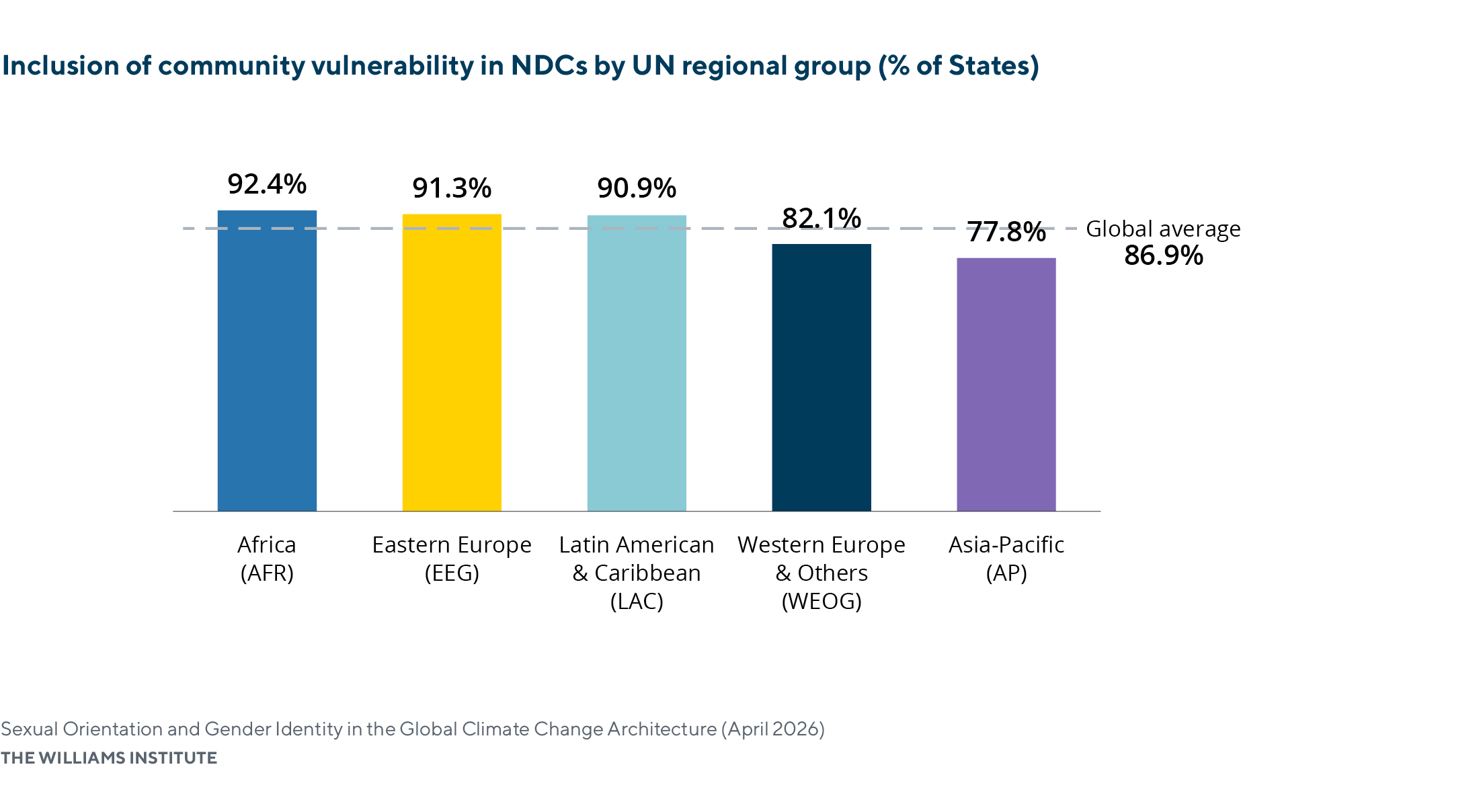
- Within UN regions, Africa (AFR), Eastern Europe (EEG), and Latin America and the Caribbean (LAC) show the highest proportion of countries that mention vulnerability (92.4% in AFR, 91.3% in EEG, and 90.9% in LAC).
- Western European and other countries (WEOG) have a relatively high proportion of countries (82.1%) that include vulnerability analysis in NDCs.
- Asia-Pacific (AP) has the lowest proportion, with 77.8% of countries in the region including vulnerability analysis in NDCs.
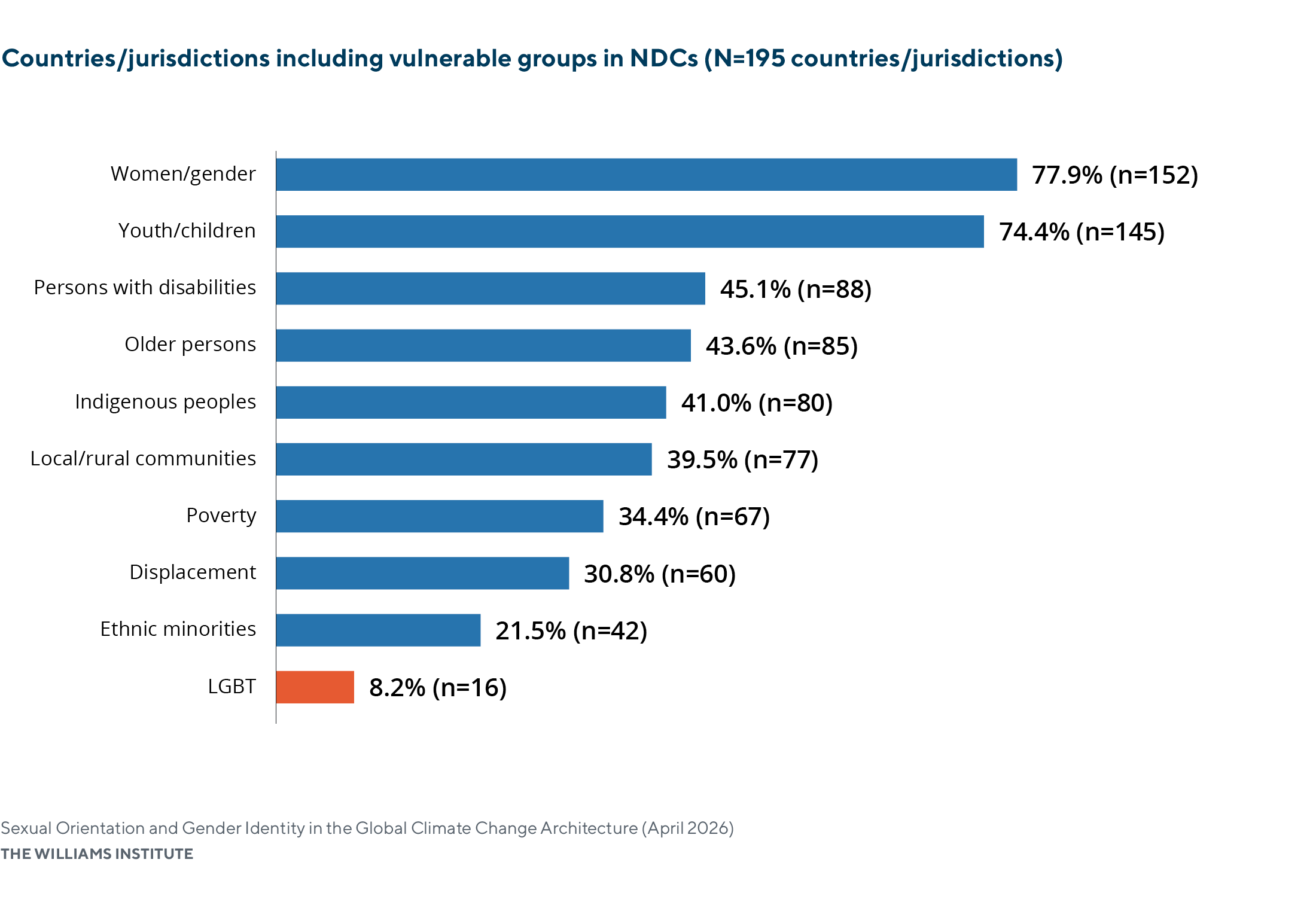
Similarly, the evidence suggests that groups explicitly named in the Paris Agreement (i.e., women, persons with disabilities, Indigenous Peoples, local communities, migrants, children) are more often explicitly cited in the NDCs of parties to the Agreement. Of the 165 State parties that include vulnerability mention or analysis in their NDCs:
- About three-quarters include mentions to women (77.9%) and youth/children (74.4%).
- Fewer parties mention persons with disabilities (45.1%), older persons (43.6%), Indigenous Peoples (41%), and/or local communities (39.5%).
- About one-third mention forcibly displaced persons and migrants (30.8%).
The climate change architecture upholds structural imbalances.
The climate architecture reproduces pre-existing patterns of inequality. Treaty-level visibility systematically structures who becomes legible to climate finance and adaptation systems. Groups not named in the Paris Agreement are rarely acknowledged in NDCs, and when recognition occurs, it appears to be fragile:
- Ethnic minorities are recognized by about one-fifth (21.5%) of parties to the Paris Agreement, and LGBT persons by fewer than one out of ten (8.2%).
- Among groups that are seen as politically sensitive in some contexts (i.e., LGBT persons, migrants, and ethnic minorities), including some mentioned in the Paris Agreement, explicit recognition by parties to the Agreement is inconsistent and may even backslide in subsequent NDCs, suggesting that their recognition is not part of consolidated State policy.
LGBT/SOGI inclusion remains rare and vulnerable to reversal.
While this report does not establish direct causality between recognition of a particular community in the Paris Agreement and in a State’s NDC, the evidence suggests that the Paris Agreement functions as a gatekeeping framework, shaping which communities are considered relevant to national climate planning by States. By failing to recognize LGBT realities, policies overlook both specific risks and sources of resilience:
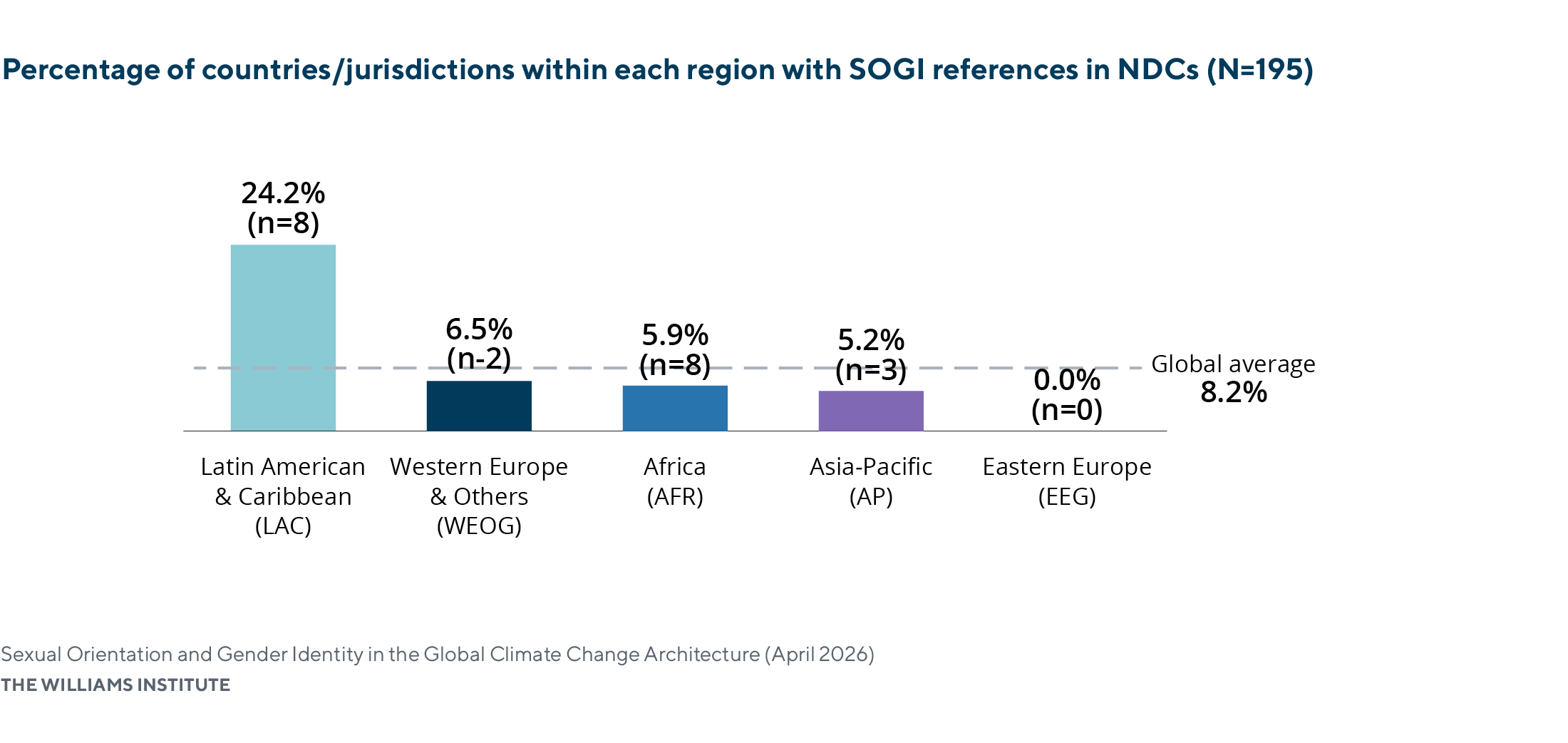
- LAC is the region with the highest percentage of LGBT/SOGI inclusion in NDCs, with 24.2% of its countries (8 out of 33) mentioning LGBT persons or gender diversity. 6.5% of countries in WEOG include LGBT/SOGI in NDCs, while 5.9% in AFR and 5.1% in AP mention LGBT/SOGI. EEG has a zero-mention rate.
- Within this limited group, evidence suggests that once an NDC explicitly mentions LGBT persons or gender diversity, inclusion tends to persist across subsequent NDC cycles—a pattern observed in 8 of the 10 countries that recognized LGBT persons in their first NDC. However, this inclusion may not be stable where LGBT rights are subject to active political contestation. A change in government can erode practical recognition in national policy implementation even where NDC language formally remains intact.
- The prevailing binary interpretation of gender within climate frameworks prevents operational recognition of sexual and gender diversity, replicating patterns of bias and discrimination seen in disaster risk reduction frameworks and humanitarian responses.
Visibility in NDCs affects access to climate finance and adaptation planning.
Climate finance architecture compounds invisibility. Groups not mentioned in the Paris Agreement—and therefore rarely included in NDCs—face greater difficulty accessing climate finance and just transition resources, due to the following:
- Lower likelihood of being included in vulnerability assessments
- Reduced participation in stakeholder processes
- Fewer targeted adaptation measures
Importantly, the absence of SOGI considerations is not isolated to climate change. It reflects broader patterns across humanitarian assistance, disaster risk reduction, national statistical systems, and development planning. The result is a structural, cross-sectoral invisibility that prevents LGBT persons from being identified as rights-holders within adaptation, resilience, or just-transition policies. When communities are invisible in national reporting, they are also absent from needs assessments, stakeholder consultations, and the design of public investment priorities that shape access to climate finance.
A rights-based lens reveals State responsibility.
The report demonstrates that failure to include SOGI is not merely a policy gap but a failure to comply with established principles of equality, participation, and accountability required under international human rights law.
Evidence suggests that discriminatory practices, legal barriers, and administrative obstacles, which in their turn reverberate on family, community, and social exclusion, exacerbate the risk to which LGBT persons are exposed in connection to climate change, and create differentiated forms of risk, including discrimination and violence in humanitarian settings. Patterns recur across all areas where evidence is available, including health, housing, education, employment, and political participation.
Some barriers—chief among them, the use of State power to criminalize or otherwise render same-sex intimacy and certain forms of gender identity illegal—constitute severe and structural impediments to the furtherance of human rights of LGBT persons. Their specific impact on different realms of life, including climate action, has nevertheless been vastly underexplored. In the same vein, climate change governance is yet to either acknowledge or dedicate proper attention to ascertaining the impact of generalized discrimination and violence on LGBT persons on the efficiency and effectiveness of climate action in areas such as employment, including the transition away from carbon-intensive economies.
Systemic exclusion stems from interconnected and interdependent actions and omissions.
LGBT persons face persistent invisibility and hostility in climate research and policy. Institutional pathways include data suppression, exclusion from policy processes, and administrative definitions that reinforce normative family models.
Climate impacts intersect with other axes of marginalization. LGBT persons who are also racialized, disabled, Indigenous, youth, elderly, migrants, or economically disadvantaged face layered vulnerabilities.
Despite widespread exclusion, the report highlights promising developments.
National Adaptation Plans (NAP): A small group of States has taken the lead in recognizing LGBT communities and populations among those requiring differentiated approaches in public policy, including climate action. Some States have started to include LGBT persons in adaptation planning, with provisions for participation, health care, and gender-responsive budgeting.
NDCs: While in many cases the recognition of LGBT persons appears to be obscure, formulaic, or of little consequence in terms of policy, a few recent NDCs nonetheless incorporate reference to LGBT persons that draw on evidence, refer to human rights standards, and/or lead to plans of action.
Humanitarian Guidelines: Global headlines and standards such as the 2015 Guidelines for Integrating Gender-Based Violence Interventions in Humanitarian Action by the Inter-Agency Standing Committee (IASC) explicitly reference LGBT inclusion in humanitarian emergencies.
Intersectionality: A relatively small but growing body of research highlights the importance of intersectionality in climate policy, acknowledging that people experience climate impacts as individuals shaped by multiple and overlapping forms of identity, including race, class, disability, sexual orientation, and gender identity.
Community-Led Organizing: Civil society organizations and LGBT-led groups are increasingly engaging in climate-justice advocacy, documenting community-based responses and demanding inclusion in policy spaces. Despite systemic exclusion, LGBT communities have shown remarkable leadership and resilience in climate response through informal support networks and grassroots organizing.
Growing International Recognition: UN Special Rapporteurs, global and regional treaty bodies, and independent experts and scholars have started to draw attention to the ways in which climate change affects LGBT rights and inclusion.
Download the full report