In the United States, HIV criminalization intersects two overlapping epidemics: the HIV epidemic and the epidemic of over-policing and mass incarceration. Both epidemics disproportionately affect Black Americans, as does HIV criminalization. Black people in the United States are more likely to be diagnosed and live with HIV while also having less access to HIV treatment and prevention. Black Americans also experience greater police surveillance and harsher punishment in the criminal legal system. Together, these twin epidemics place Black people in the U.S. living with HIV at increased risk of criminal legal system involvement because of both their race and HIV status. In this brief, we present information on the racial dynamics of America’s HIV epidemic and criminal legal system, followed by an examination of racial patterns from Williams Institute reports on HIV criminalization.
Black Americans and the Dual Epidemics
Black Americans and the HIV Epidemic
About 1.2 million people in the United States aged 13 and older were living with HIV at the end of 2022, according to the Centers for Disease Control and Prevention (CDC). Today, for many, HIV can be managed with medications, which can also prevent HIV transmission. Despite these advances, substantial racial inequalities in HIV prevention and treatment persist.
Black Americans are more likely than any other race/ethnicity to be living with HIV or newly diagnosed with HIV.
- In 2023, Black Americans accounted for about 38% of new HIV diagnoses and 39% of people living with HIV, despite representing approximately 12% of the U.S. population. The HIV diagnosis rate for Black Americans was about 41.9 per 100,000 in 2023, versus the overall U.S. rate of about 13.7 per 100,000.
- Among women, Black women had the highest HIV diagnosis rate in 2023 (19.6 per 100,000)— approximately 11 times the rate for white women (1.8 per 100,000). Young Black men aged 13 to 24 accounted for 47% of all HIV diagnoses among youth in 2023; young white men accounted for 3% of new diagnoses that year.
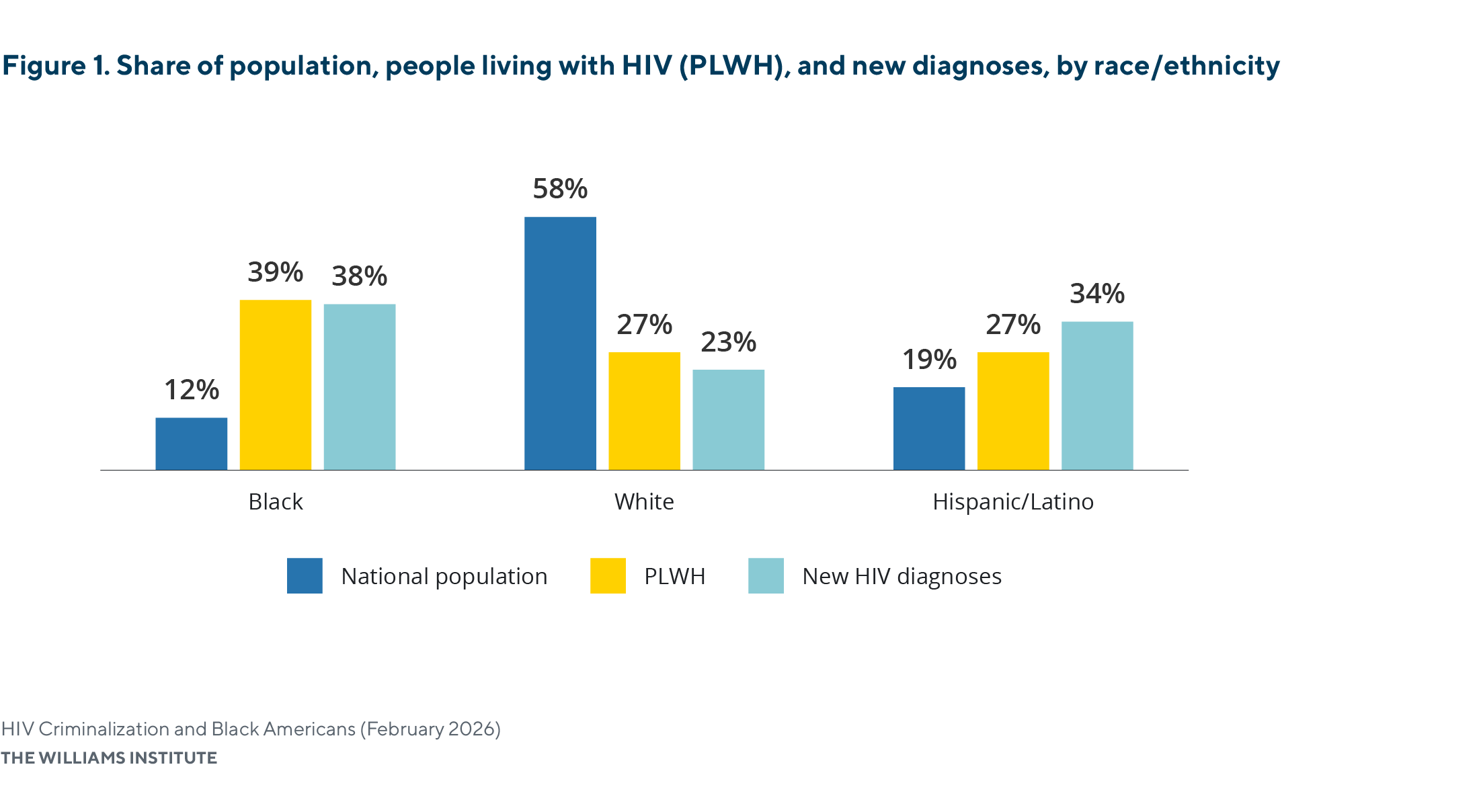
Source: CDC, HIV Surveillance Report Figures 2023
Black Americans are less likely to be on medications that treat and prevent HIV.
- In 2022, the most recent year available, about 88% of Black people with HIV knew of their HIV positive status, 64% were linked to HIV care, and 53% were virally suppressed. These were below the corresponding indicators for white Americans: 89% diagnosed, 70% linked to care, 63% virally suppressed. Black Americans’ PrEP to need ratio—the number of Pre-exposure Prophylaxis (PrEP) users divided by the number of new HIV diagnoses—was 5.8 in 2024 compared to 41.7 for white Americans, suggesting continued inequalities in access to prevention services.
- Black Americans are also less likely to have health insurance to manage, detect, and prevent HIV: 12.3% of Black adults aged 19 to 64 lacked health insurance in 2024, compared to 6.8% among white Americans.
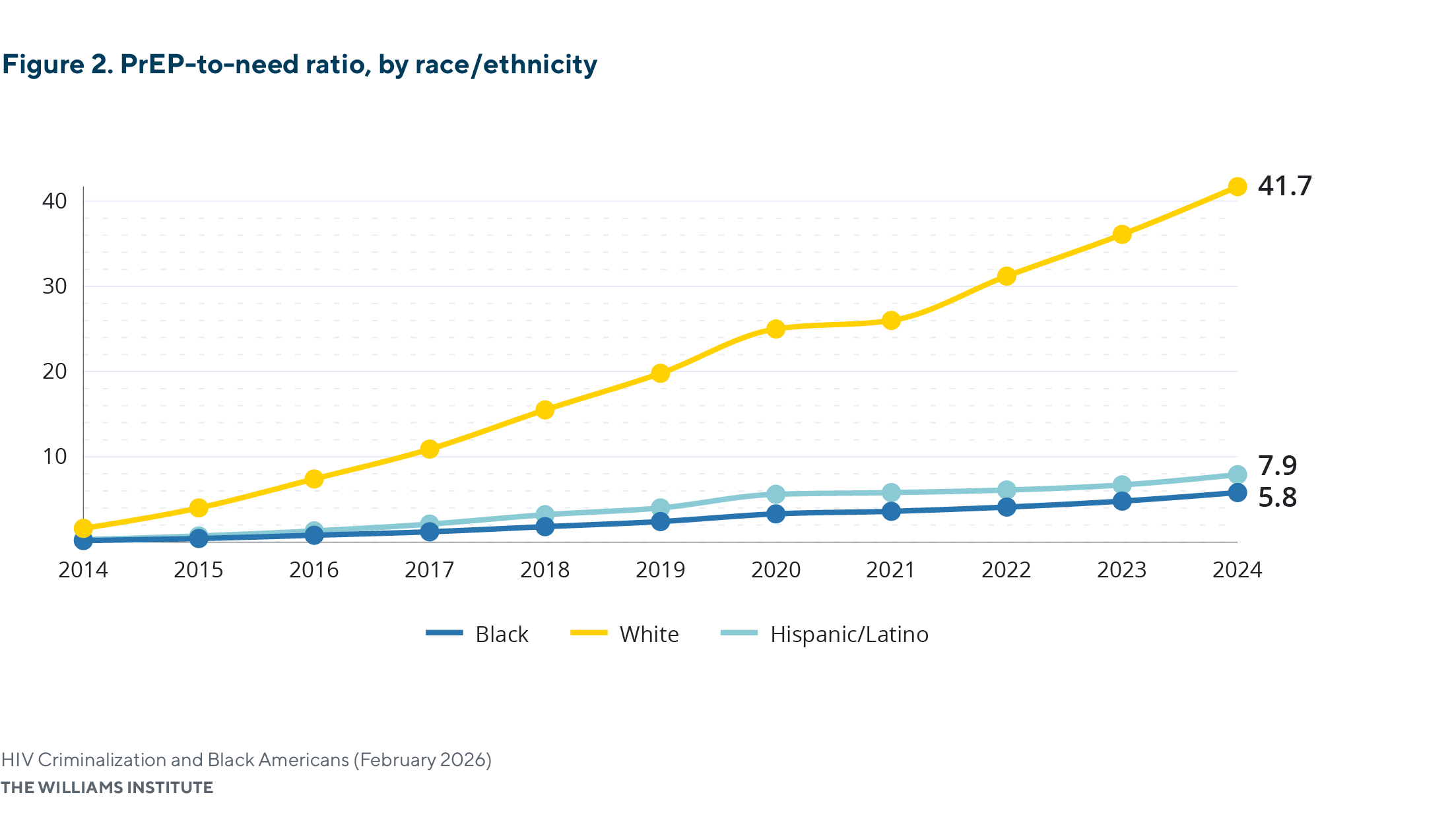
Note: The PrEP-to-need ratio reflects the number of PrEP users in a group for every new HIV diagnosis in that group. A lower PrEP-to-need ratio indicates more unmet need for PrEP.
Source: AIDSVu, Racial/Ethnic Disparities and HIV in the United States
Black Americans and Contact with the Criminal Legal System
About 1.9 million people were incarcerated in the United States in 2023, according to the Bureau of Justice Statistics. Approximately 79 million Americans—roughly one in three adults—have a criminal record. The United States incarcerates more people than nearly any other country in the world, both in absolute numbers and per capita. Within this system, Black Americans face a heightened risk of criminal legal contact at every stage, including being searched or arrested by police and incarcerated.
Black Americans are more likely than white people to be stopped, searched, and arrested by law enforcement.
- Black drivers are about 20 – 30% more likely to be stopped than white drivers, and Black drivers are also about 1.5 to 2 times more likely to be searched than white drivers.
- Nationally, Black people are nearly three times as likely as white people to be arrested after contact with police for a traffic stop.

Source: U.S. Department of Justice, Contacts Between Police and the Public
Black Americans are more harshly punished than white people.
- After conviction, Black defendants receive longer sentences than white defendants for similar offenses.
- Black defendants are more likely to face charges carrying mandatory minimum sentences and less likely to receive charge reductions than white defendants.
- Prison incarceration rates for Black Americans are nearly five times higher than for white Americans, and jail incarceration rates are about 3.5 times higher.
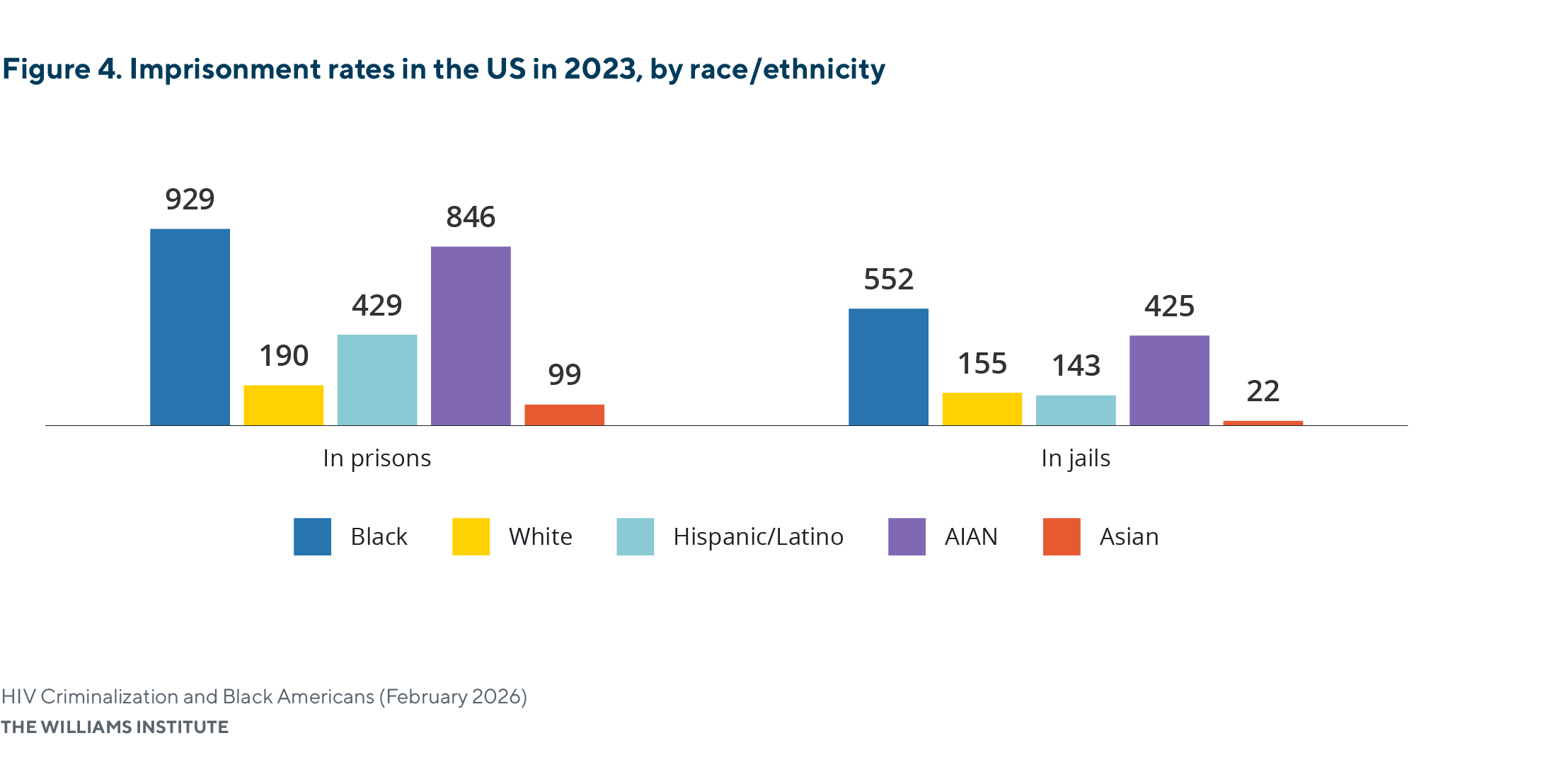
Note: Imprisonment rates reflect the number of individuals per 1,000 people of a demographic group who were sentenced under the jurisdiction of state or federal correctional authorities in 2023, as well as those held in jails at the midpoint of the year.
Source: U.S. Department of Justice, Prisoners in 2023 – Statistical Tables and Jail Inmates in 2023 – Statistical Tables
Black Americans and HIV Criminalization
The disproportionate burdens of the HIV epidemic and of contact with the criminal legal system experienced by Black Americans converge in HIV criminalization.
HIV Criminalization Basics
- HIV criminalization refers to laws that make otherwise legal conduct illegal, or that create harsher penalties for illegal conduct because of a person’s HIV-positive status.
- Nationally, 32 states criminalized people living with HIV at the end of 2025.
- Most HIV-related criminal laws do not require actual HIV transmission or the intent to transmit HIV. Some laws criminalize conduct that cannot transmit HIV and ignore mitigation and prevention strategies.
- HIV criminalization can carry heavy prison sentences and lifelong collateral consequences, from felony conviction and sex offender registration.
Most HIV criminal laws were enacted before HIV treatment and prevention tools were widely available. There has been a push in recent years to reform or repeal these laws. The most recent federal National HIV/AIDS Strategy states that “[HIV criminal] laws have not increased disclosure and may discourage HIV testing, increase stigma against people with HIV, and exacerbate disparities. To end the HIV epidemic, public health, criminal justice, and legislative systems must work together to ensure that laws protect the community, are evidence-based and just, and support public health efforts.”
Williams Institute Findings on HIV Criminalization and Black Americans
Between 2015 and 2025, the Williams Institute analyzed the enforcement of HIV-related criminal laws in 16 states. This research shows that Black Americans are more likely to encounter the criminal legal system because of an HIV-related criminal allegation and are more likely to be convicted of an HIV crime once they have contact with the criminal system.
Black Americans are more likely to be arrested for HIV-related allegations.
- Across every state for which we have data—16 in total—Black Americans were arrested for HIV crimes at higher rates than their overall share of the state population. In 64% of states analyzed, Black Americans were arrested at higher rates than their share of people living with HIV (PLWH) in the state.
- For example, in California, Black people were 6% of the state population and 18% of people living with HIV, but 39% of HIV-related arrests. In Maryland, Black people were 30% of the state population but 71% of people living with HIV and 82% of HIV-related arrests in the state.
Black Americans are more likely to be convicted of HIV-related allegations.
- Across all 16 states analyzed, Black Americans were convicted at higher rates than their overall share of the state population. In 75% of states analyzed, Black Americans were convicted at higher rates than their share of people living with HIV in the state (See Figure 5).
- For example, in Nevada, Black people were 10% of the state’s population and 28% of people living with HIV in the state, but 43% of HIV-related convictions. In Virginia, Black men accounted for about 18% of the state’s population but 68% of HIV-related convictions.
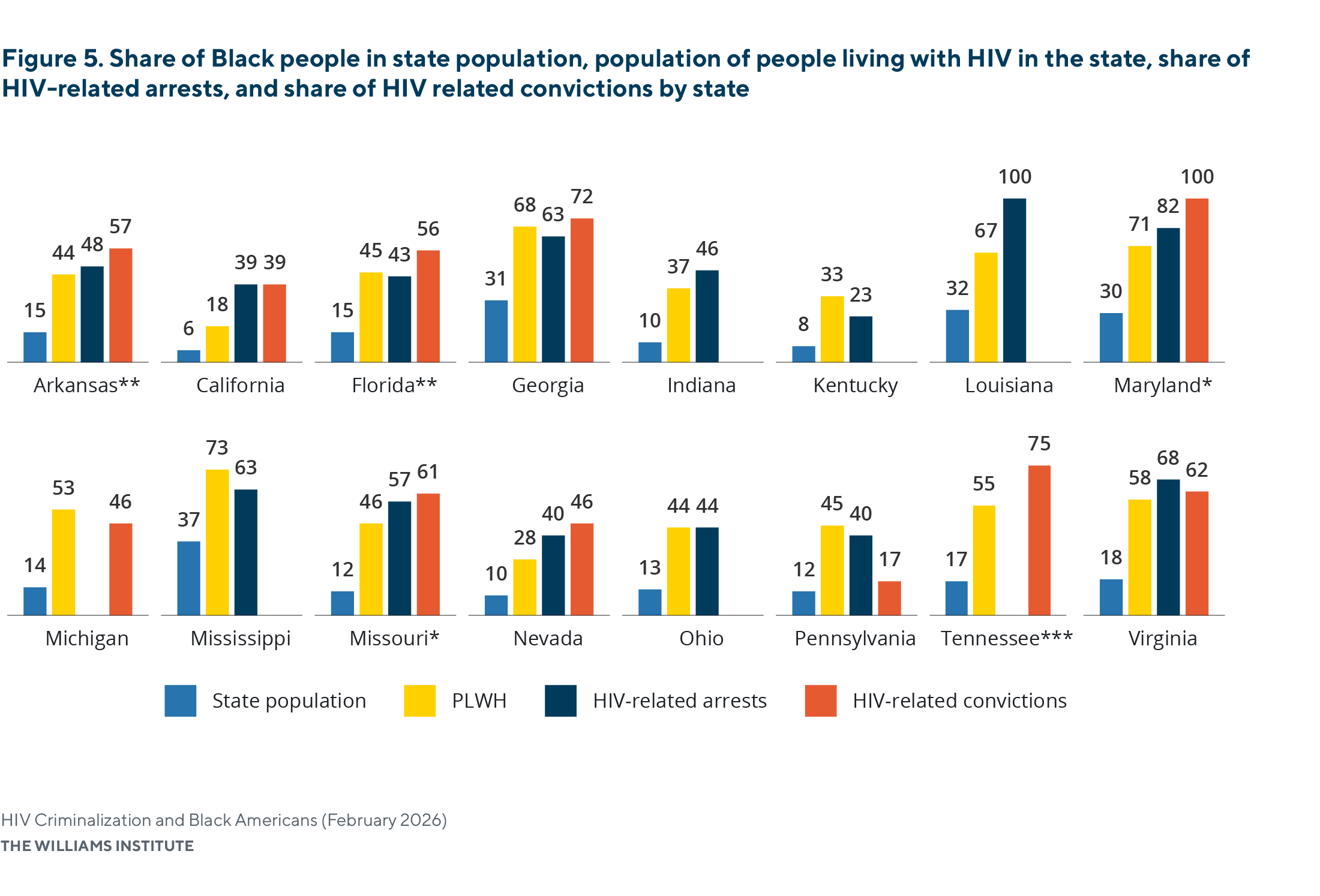
Note: *Figure represents criminal cases; arrests not available. **Figure represents incarcerations; convictions not available. ***Figure represents sex offender registrations; convictions not available.
Black Americans are more likely to face harsh post-conviction penalties like sex offender registration.
- In all states for which we have data, Black Americans are more likely to be placed on a sex offender registry for an HIV-related conviction.
- For example, in Louisiana, Black people were 32% of the state’s population and 67% of people living with HIV, but 74% of people on the registry with an HIV-related conviction.
- Likewise, in Tennessee, Black people were 17% of the state’s population and 55% of people living with HIV, but 74% of people on the sex offender registry with an HIV-related conviction.
In some states, men and women, including Black men and women, experience HIV criminalization differently.
- For example, in Tennessee, about three-fourths (77%) of those on the state’s sex offender registry for an HIV-related sex work conviction were women, and the majority were Black women (57%); only 22% were Black men. In contrast, 90% of people on the registry for an HIV-related exposure conviction were men, and the majority were Black men (64%); only 4% were Black women.
- In Florida, 81% of people arrested for an HIV-related sex work allegation were women, and 28% were Black women; 13% were Black men. In contrast, 73% of those arrested under the state’s HIV-related exposure law were men, and 36% were Black men; 11% were Black women.
Conclusion
Black Americans are disproportionately harmed by America’s dual epidemics of HIV and over-policing and mass incarceration. They continue to be more likely to be newly diagnosed with and to be living with HIV than their non-Black counterparts, and to be subjected to heightened surveillance, arrest, and conviction within the criminal legal system. As a result, Black Americans are more likely to be criminalized for their HIV status through HIV-related criminal laws and to come into contact with the criminal legal system following an HIV-related allegation. These heighten the risk of criminalization for Black Americans living with HIV—risks that affect Black men and Black women often in unique ways.
Discussing the negative effects of HIV criminalization on ending the HIV epidemic in the United States, in 2023, the CDC recommended that “[w]hen a law meant to protect the public is not working as intended, is unjust, and may be hurting efforts to keep communities healthy, common solutions must be found to better meet public health and public safety goals.” Such reforms have the potential to benefit both PLWH and those at risk of HIV by decreasing stigma and shifting policy from carceral to public health strategies for HIV treatment and prevention.
Download the full brief
